Patient-controlled analgesia: Difference between revisions
CSV import |
CSV import Tags: mobile edit mobile web edit |
||
| Line 26: | Line 26: | ||
{{stub}} | {{stub}} | ||
<gallery> | |||
File:PCA-01.JPG|Patient-controlled analgesia device | |||
File:PCA-02.JPG|Another view of a patient-controlled analgesia device | |||
</gallery> | |||
Latest revision as of 01:51, 17 February 2025
Patient-controlled analgesia (PCA) is a method of pain control that allows the patient to control the administration of pain relief medication. This method is most commonly used in a hospital setting, but can also be used at home under the supervision of a healthcare professional.
Overview[edit]
PCA allows patients to self-administer analgesics (pain-relieving drugs) as needed. The patient presses a button to deliver a dose of medication through an intravenous line. The system is programmed to limit the amount of medication that can be administered in a certain period of time, to prevent overdose.
Advantages[edit]
PCA has several advantages over traditional methods of pain relief. It allows for immediate relief of pain, as the patient does not have to wait for a nurse to administer medication. It also allows the patient to control their own pain relief, which can lead to a greater sense of control and satisfaction with their care.
Disadvantages[edit]
There are also some disadvantages to PCA. Some patients may be hesitant to use the system for fear of becoming addicted to the medication. There is also a risk of overdose if the system is not properly programmed or if the patient uses the system too frequently.
Medications[edit]
The most common medications used in PCA are opioids, such as morphine, hydromorphone, and fentanyl. These medications are effective at relieving pain, but can also have side effects such as nausea, vomiting, and constipation.
Safety[edit]
Safety is a major concern with PCA. The system is designed to prevent overdose, but errors can still occur. It is important for healthcare professionals to monitor the patient closely and to educate the patient and their family about the proper use of the system.
See also[edit]
 |
 |
-
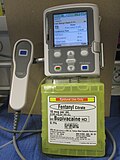 Patient-controlled analgesia device
 -
 Another view of a patient-controlled analgesia device


