Chelidonium majus: Difference between revisions
CSV import Tags: mobile edit mobile web edit |
CSV import Tags: mobile edit mobile web edit |
||
| Line 26: | Line 26: | ||
{{Flora-stub}} | {{Flora-stub}} | ||
{{Medicine-stub}} | {{Medicine-stub}} | ||
<gallery> | |||
File:Chelidonium_majus_Koeh-033.jpg|Chelidonium majus illustration | |||
File:Chelidonium_majus_sap_3_AB.jpg|Chelidonium majus sap | |||
</gallery> | |||
Revision as of 01:49, 17 February 2025
Chelidonium majus, commonly known as greater celandine, is a perennial herbaceous plant in the poppy family, Papaveraceae. It is native to Europe and western Asia and has been introduced to North America.
Description
Chelidonium majus is a herbaceous perennial plant that grows to 30-120 cm in height. The leaves are pinnate with lobed and wavy-edged margins. The flowers are yellow and appear from late spring to summer. The fruit is a slender capsule that contains numerous black seeds.
Distribution and habitat
Chelidonium majus is native to Europe and western Asia. It has been introduced to North America, where it is found in disturbed areas such as roadsides and waste places. It prefers moist, well-drained soils and can be found in both sun and partial shade.
Uses
Chelidonium majus has been used in traditional medicine for centuries. It has been used to treat a variety of ailments, including digestive disorders, respiratory problems, and skin conditions. However, its use is not without risk, as the plant contains several toxic alkaloids.
Toxicity
Chelidonium majus contains several toxic alkaloids, including chelidonine, chelerythrine, and sanguinarine. These compounds can cause serious health problems if ingested in large amounts. Symptoms of poisoning can include nausea, vomiting, dizziness, and in severe cases, respiratory failure and death.
Conservation
While Chelidonium majus is not currently considered threatened, it is susceptible to habitat loss due to urban development and agricultural intensification. Conservation efforts are focused on preserving its natural habitats and preventing its overharvesting for medicinal use.
See also

This flora-related article is a stub. You can help WikiMD by expanding it.

-
Chelidonium majus illustration
-
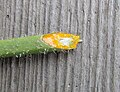 Chelidonium majus sap


