Cefonicid: Difference between revisions
CSV import Tags: mobile edit mobile web edit |
CSV import |
||
| Line 44: | Line 44: | ||
{{Medicine-stub}} | {{Medicine-stub}} | ||
<gallery> | |||
File:cefonicid.png|Cefonicid | |||
File:cefonicid_synthesis.svg|Cefonicid synthesis | |||
</gallery> | |||
Latest revision as of 01:49, 17 February 2025
Cefonicid is a second-generation cephalosporin antibiotic used in the treatment of various bacterial infections. It is a beta-lactam antibiotic that works by inhibiting the synthesis of the bacterial cell wall, leading to cell death. Cefonicid is particularly effective against Gram-positive bacteria and some Gram-negative bacteria, making it a useful agent in the treatment of infections such as pneumonia, skin infections, and urinary tract infections (UTIs).
Mechanism of Action[edit]
Cefonicid inhibits the synthesis of the bacterial cell wall by binding to penicillin-binding proteins (PBPs). This binding interferes with the final transpeptidation step of peptidoglycan synthesis in bacterial cell walls, thus inhibiting cell wall biosynthesis. The result is the weakening of the bacterial cell wall and ultimately cell lysis and death.
Pharmacokinetics[edit]
After administration, cefonicid is well distributed throughout the body, including in the pleural fluid, synovial fluid, and bone. It has a longer half-life compared to many other cephalosporins, which allows for once-daily dosing. Cefonicid is primarily excreted unchanged in the urine.
Clinical Uses[edit]
Cefonicid is used to treat a variety of bacterial infections, including:
It is also used as a prophylactic agent in certain surgical procedures to prevent postoperative infections.
Side Effects[edit]
Common side effects of cefonicid include:
As with all antibiotics, there is a risk of developing Clostridium difficile-associated diarrhea (CDAD) due to the alteration of the normal flora of the colon.
Contraindications[edit]
Cefonicid is contraindicated in patients with a known allergy to cephalosporins. Caution is advised in patients with a history of penicillin allergy, as cross-reactivity may occur.
Drug Interactions[edit]
Cefonicid may interact with other medications, such as:
- Probenecid, which can increase the concentration of cefonicid by decreasing its renal excretion.
- Anticoagulants (e.g., warfarin), as cefonicid may enhance the anticoagulant effect.
Conclusion[edit]
Cefonicid is a valuable antibiotic in the treatment of various bacterial infections due to its broad spectrum of activity and once-daily dosing. However, like all antibiotics, it should be used judiciously to prevent the development of resistance.

-
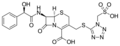 Cefonicid
 -
 Cefonicid synthesis


