Dextrin: Difference between revisions
CSV import |
CSV import |
||
| Line 26: | Line 26: | ||
{{Chemistry-stub}} | {{Chemistry-stub}} | ||
{{Nutrition-stub}} | {{Nutrition-stub}} | ||
<gallery> | |||
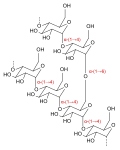
File:Dextrin Poly-(1-4)-alpha-D-Glucose.svg|Dextrin Poly-(1-4)-alpha-D-Glucose | |||
File:Dextrin_skeletal.svg|Dextrin skeletal structure | |||
</gallery> | |||
Revision as of 01:45, 17 February 2025
Dextrin refers to a group of low-molecular-weight carbohydrates produced by the hydrolysis of starch or glycogen. They are polymers of glucose and are intermediate products in the digestion of starch by enzymes such as amylase and glycoamylase. Dextrins are soluble in water, and their solubility and structure depend on the method of preparation. They are used in various industrial applications, including as adhesives, in the textile industry, as a crispness enhancer in food, and in the pharmaceutical industry as excipients in tablets.
Production
Dextrins are produced through the application of heat, acid, or enzymes on starch. The process, known as dextrinization, breaks down the starch into shorter chains of glucose molecules. The type of dextrin produced (e.g., white or yellow dextrin) depends on the conditions under which dextrinization occurs. For example, white dextrins are obtained by heating starch in the presence of acid, while yellow dextrins result from heating starch without acid.
Types and Uses
There are several types of dextrin, including maltodextrin, cyclodextrin, and pyrodextrin, each with specific properties and uses.
- Maltodextrin is a commonly used dextrin in the food industry, known for its ability to serve as a thickener, filler, or preservative in various food products.
- Cyclodextrin is notable for its ring-shaped structure, making it useful in pharmaceuticals for enhancing the solubility and stability of drugs.
- Pyrodextrin is used in adhesives and as a binder due to its ability to form a strong bond when mixed with other substances.
Health and Nutrition
In the context of nutrition, dextrins are considered a source of dietary fiber, particularly resistant dextrin, which is not digested in the small intestine but is fermented in the colon, promoting gut health. However, the impact of dextrins on health can vary depending on the type and amount consumed. For instance, excessive intake of certain dextrins may lead to digestive discomfort in some individuals.
Regulation and Safety
The use of dextrins in food and pharmaceutical products is regulated by various health authorities worldwide, including the Food and Drug Administration (FDA) in the United States and the European Food Safety Authority (EFSA) in the European Union. These organizations assess the safety of dextrins and provide guidelines on their acceptable levels in different products.
Research and Development
Ongoing research into dextrins focuses on expanding their applications and improving their functionality. This includes developing new methods of production, exploring their potential as prebiotics, and investigating their use in novel drug delivery systems.


-
Dextrin Poly-(1-4)-alpha-D-Glucose
-
 Dextrin skeletal structure


-alpha-D-Glucose.svg)