Fascia lata: Difference between revisions
CSV import |
CSV import |
||
| Line 25: | Line 25: | ||
[[Category:Surgical procedures and techniques]] | [[Category:Surgical procedures and techniques]] | ||
{{anatomy-stub}} | {{anatomy-stub}} | ||
<gallery> | |||
File:Fascia_lata Gray542.png|Description of Fascia_lata Gray542.png | |||
File:Gray545.png|Description of Gray545.png | |||
</gallery> | |||
Revision as of 01:45, 17 February 2025
Fascia lata is a layer of fibrous tissue that envelops the human body in a three-dimensional web from head to toe. It is a type of connective tissue that surrounds muscles, groups of muscles, blood vessels, and nerves, binding some structures together, while permitting others to slide smoothly over each other.
Anatomy
The fascia lata is the deep fascia of the thigh. It encloses the thigh muscles and forms the outer limit of the fascial compartments of thigh, which are internally separated by intermuscular septa. The fascia lata is thickened at its lateral side where it forms the iliotibial tract, a structure that runs to the tibia and helps to stabilize the hip and knee.
Function
The fascia lata plays a crucial role in lower limb movements. It provides a division of the thigh into compartments that have different functions and muscles. The fascia lata also provides a surface for muscle attachment, helps in the distribution of forces produced by the muscles, and provides a passive tension to assist in the function of muscles.
Clinical significance
In medicine, a piece of fascia lata can be used in reconstructive surgery. It can be harvested as a free graft, or as a pedicled graft (still attached to the body at one end), for example in fascia lata graft surgery. It is used in a variety of surgical procedures, including hernia repair, breast reconstruction, and cranial cruciate ligament reconstruction in the knee.
See also
References
<references />

-
Description of Fascia_lata Gray542.png
-
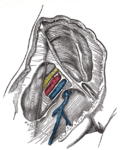 Description of Gray545.png


