Activity coefficient: Difference between revisions
CSV import |
CSV import |
||
| Line 43: | Line 43: | ||
[[Category:Thermodynamics]] | [[Category:Thermodynamics]] | ||
[[Category:Physical chemistry]] | [[Category:Physical chemistry]] | ||
== Activity Coefficient == | |||
<gallery> | |||
File:UNIQUACRegressionChloroformMethanol.png | |||
</gallery> | |||
Latest revision as of 22:13, 16 February 2025
A measure of deviation from ideal behavior in a mixture
Activity coefficient[edit]
The activity coefficient is a factor used in thermodynamics to account for deviations from ideal behavior in a mixture of chemical substances. In an ideal solution, the interactions between molecules are the same as those in the pure components, and the activity coefficient is equal to one. However, in real solutions, interactions can differ, leading to activity coefficients that deviate from unity.
Definition[edit]
In a mixture, the activity \( a_i \) of a component \( i \) is related to its concentration \( c_i \) by the equation:
\[
a_i = \gamma_i c_i
\]
where \( \gamma_i \) is the activity coefficient of component \( i \). The activity coefficient quantifies the non-ideal behavior of the solution.
Importance[edit]
Activity coefficients are crucial in chemical thermodynamics for calculating the chemical potential of a species in a mixture. They are used in the Gibbs free energy calculations and are essential for understanding phase equilibria, reaction equilibria, and electrolyte solutions.
Models for Activity Coefficients[edit]
Several models exist to estimate activity coefficients, including:
- Debye–Hückel theory: Used for dilute electrolyte solutions.
- UNIQUAC (Universal Quasi-Chemical): A model for predicting activity coefficients in non-electrolyte solutions.
- NRTL (Non-Random Two-Liquid): A model that accounts for non-randomness in liquid mixtures.
Applications[edit]
Activity coefficients are used in various fields such as:
- Chemical engineering: For designing separation processes like distillation and extraction.
- Environmental science: To model the behavior of pollutants in natural waters.
- Pharmaceuticals: In the formulation of drugs to ensure proper solubility and stability.
Related pages[edit]
Gallery[edit]
-
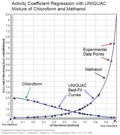 Graph showing UNIQUAC regression for chloroform and methanol.

