Cavitation (embryology): Difference between revisions
CSV import Tags: mobile edit mobile web edit |
CSV import |
||
| Line 30: | Line 30: | ||
{{anatomy-stub}} | {{anatomy-stub}} | ||
== Cavitation (embryology) == | |||
<gallery> | |||
File:Diagram_of_Blastocyst_stage.png|Diagram of Blastocyst stage | |||
</gallery> | |||
Latest revision as of 22:13, 16 February 2025
Cavitation (Embryology)
Cavitation is a critical process in embryology that involves the formation of cavities within the blastocyst during the early stages of mammalian development. This process is essential for the formation of the blastocoel, a fluid-filled cavity that plays a significant role in the subsequent stages of embryonic development.
Process[edit]
Cavitation begins with the formation of a morula, a solid ball of cells. The cells in the morula then undergo compaction, a process that segregates the cells into an outer layer, the trophectoderm, and an inner cell mass. Following compaction, the cells of the trophectoderm begin to secrete fluid, leading to the formation of a small cavity. This cavity expands as more fluid is secreted, eventually forming the blastocoel.
Role in Embryonic Development[edit]
The formation of the blastocoel through cavitation is a critical step in embryonic development. The blastocoel provides a space for the inner cell mass to develop into the embryo proper, while the trophectoderm develops into the placenta. The blastocoel also plays a role in gastrulation, a process that forms the three primary germ layers of the embryo.
Clinical Significance[edit]
Abnormalities in cavitation can lead to developmental disorders. For example, failure of cavitation can result in a blighted ovum, a condition where the blastocyst does not develop properly, leading to early pregnancy loss.
See Also[edit]
References[edit]
<references />

Cavitation (embryology)[edit]
-
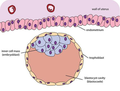 Diagram of Blastocyst stage

