2007 Bernard Matthews H5N1 outbreak: Difference between revisions
CSV import |
CSV import |
||
| Line 40: | Line 40: | ||
[[Category:Health disasters in the United Kingdom]] | [[Category:Health disasters in the United Kingdom]] | ||
[[Category:2007 disease outbreaks]] | [[Category:2007 disease outbreaks]] | ||
== 2007 Bernard Matthews H5N1 outbreak == | |||
<gallery> | |||
File:2007-Map-Avianflu-zones.png|Map showing avian flu zones during the 2007 Bernard Matthews H5N1 outbreak | |||
</gallery> | |||
Latest revision as of 22:10, 16 February 2025
2007 Bernard Matthews H5N1 Outbreak[edit]
The 2007 Bernard Matthews H5N1 outbreak was a significant event in the United Kingdom involving the H5N1 strain of the avian influenza virus. The outbreak occurred at a poultry farm owned by Bernard Matthews, a major producer of turkey products, located in Suffolk, England.
Background[edit]
Avian influenza, commonly known as bird flu, is an infectious viral disease of birds. Most avian influenza viruses do not infect humans; however, some, such as H5N1, have caused serious infections in people. The H5N1 virus is highly pathogenic and has been responsible for numerous outbreaks in poultry worldwide.
The Outbreak[edit]
The outbreak was first detected on 30 January 2007, when dead turkeys were found at the Bernard Matthews farm in Holton, Suffolk. Subsequent testing confirmed the presence of the H5N1 virus. The Department for Environment, Food and Rural Affairs (DEFRA) implemented control measures, including the culling of approximately 160,000 turkeys to prevent the spread of the virus.
Response and Containment[edit]
Upon confirmation of the H5N1 virus, DEFRA established a 3 km protection zone and a 10 km surveillance zone around the affected farm. Movement restrictions were imposed on poultry and poultry products within these zones. The European Union and other international bodies were notified, and the UK government worked closely with them to manage the outbreak.
Impact[edit]
The outbreak had significant economic implications for Bernard Matthews and the UK poultry industry. It also raised public health concerns, although no human cases were reported. The incident highlighted the importance of biosecurity measures in preventing the spread of avian influenza.
Aftermath[edit]
Following the outbreak, DEFRA conducted a thorough investigation to determine the source of the virus. It was suggested that the virus may have been introduced through imported poultry products, although this was not conclusively proven. The outbreak led to increased scrutiny of poultry import practices and reinforced the need for stringent biosecurity protocols.
Related Pages[edit]
Gallery[edit]
-
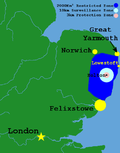 Map showing avian flu zones during the 2007 outbreak

2007 Bernard Matthews H5N1 outbreak[edit]
-
Map showing avian flu zones during the 2007 Bernard Matthews H5N1 outbreak
