Junior blood group system: Difference between revisions
CSV import |
CSV import |
||
| Line 28: | Line 28: | ||
{{Blood-group-stub}} | {{Blood-group-stub}} | ||
{{Medicine-stub}} | {{Medicine-stub}} | ||
<gallery> | |||
File:Autosomal_recessive_-_en.svg|Diagram illustrating autosomal recessive inheritance. | |||
</gallery> | |||
Latest revision as of 22:08, 16 February 2025
Junior blood group system is a human blood group system that is recognized by the International Society of Blood Transfusion (ISBT). The system is named after a patient, "Mrs. Junior", in whom the first antibody was discovered. The Junior blood group system is relatively rare and is not routinely tested for in blood transfusions.
History[edit]
The Junior blood group system was first identified in 1952 by Landsteiner and Wiener, who discovered an antibody in the serum of a pregnant woman, Mrs. Junior, that reacted with the red blood cells of her husband and 85% of random donors. This led to the identification of the Junior blood group system.
Genetics[edit]
The Junior blood group system is determined by a single gene, ABCG2, located on chromosome 4. The gene encodes a protein called ATP-binding cassette sub-family G member 2 (ABCG2), which is a member of the ATP-binding cassette (ABC) transporter superfamily. Mutations in this gene can lead to the absence of the Junior antigen on red blood cells.
Antigens[edit]
The Junior blood group system consists of two antigens, Jr^a and Jr^b. Jr^a is a high-frequency antigen, found in more than 99.9% of people, while Jr^b is a low-frequency antigen, found in less than 1% of people. The presence or absence of these antigens determines a person's Junior blood group.
Clinical significance[edit]
The Junior blood group system is not routinely tested for in blood transfusions, as the Jr^a antigen is present in almost all individuals. However, in rare cases, individuals may produce alloantibodies against the Jr^a antigen, which can cause hemolytic disease of the fetus and newborn (HDFN) and hemolytic transfusion reactions (HTR).
See also[edit]
This blood group related article is a stub. You can help WikiMD by expanding it.

-
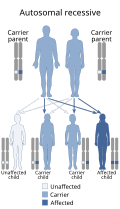 Diagram illustrating autosomal recessive inheritance.

