Organization development: Difference between revisions
CSV import Tags: mobile edit mobile web edit |
CSV import |
||
| Line 39: | Line 39: | ||
[[Category:Organizational Studies]] | [[Category:Organizational Studies]] | ||
{{management-stub}} | {{management-stub}} | ||
``` | |||
== Organization Development == | |||
<gallery> | |||
File:Systems_Model_of_Action-Research_Process.jpg|Systems Model of Action-Research Process | |||
</gallery> | |||
Latest revision as of 22:01, 16 February 2025
Organization Development (OD) is a field of research, theory, and practice dedicated to expanding the knowledge and effectiveness of people to accomplish more successful organizational change and performance. OD is an ongoing, systematic process of implementing effective organizational change. It is known for its emphasis on improving organizations through behavioral science knowledge.
Overview[edit]
Organization Development involves the process of planning and implementing changes to the structure or operations of an organization. It aims at improving organizational effectiveness and employee well-being. OD interventions are structured activities used individually or in combination to improve organizational functioning and the health of the organizational culture.
History[edit]
The field of Organization Development has evolved since the 1930s, heavily influenced by early psychologists and social scientists. Their work in human relations and the social dynamics of organizations laid the groundwork for the development of OD. Notable figures include Kurt Lewin, who is often referred to as the "father of OD" for his pioneering research into group dynamics and organizational psychology.
Key Concepts[edit]
- Change Management: The process of managing change in an organization, focusing on the human aspect of change.
- Systems Thinking: Viewing the organization as a complex system that has interrelated parts.
- Action Research: A participative inquiry process that aims to solve problems or improve practices through iterative cycles of diagnosis, action, and reflection.
- Team Development: Enhancing the effectiveness of work groups and teams within the organization.
- Leadership Development: Fostering growth in the organization's leadership capabilities to manage and lead change effectively.
OD Interventions[edit]
OD interventions can range from individual development, team development, to large-scale organizational changes. Common interventions include:
- Strategic planning
- Team building
- Leadership development
- Organizational assessments
- Change management initiatives
- Process consultation
Challenges and Criticisms[edit]
While OD can lead to significant improvements in organizational effectiveness, it is not without its challenges and criticisms. These include the potential for resistance to change, the difficulty of measuring the impact of OD interventions, and the need for sustained management support for OD initiatives to be successful.
Future Directions[edit]
The field of Organization Development continues to evolve, with a growing emphasis on technology, globalization, and diversity. Future directions may include more focus on virtual organizations, sustainability, and the integration of artificial intelligence in organizational change processes.
See Also[edit]
- Human Resource Management
- Industrial and Organizational Psychology
- Management Consulting
- Organizational Behavior

This article is a management-related stub. You can help WikiMD by expanding it!
```
Organization Development[edit]
-
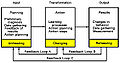 Systems Model of Action-Research Process

