Silicon tetrafluoride: Difference between revisions
CSV import |
CSV import |
||
| Line 21: | Line 21: | ||
{{Chem-stub}} | {{Chem-stub}} | ||
<gallery> | |||
File:Silicon-tetrafluoride-2D-dimensions.png|Silicon tetrafluoride 2D dimensions | |||
</gallery> | |||
Latest revision as of 21:57, 16 February 2025
Silicon tetrafluoride is a chemical compound with the formula SiF4. This tetrahedral molecule is notable for its role in the production of silicon and fluorine containing compounds, as well as its applications in microelectronics and glass manufacturing. Silicon tetrafluoride is a colorless, corrosive gas that is highly reactive, especially with water, where it forms hydrofluoric acid (HF) and silicon dioxide (SiO2).
Properties[edit]
Silicon tetrafluoride is characterized by its strong bonding between silicon and fluorine atoms, which contributes to its high reactivity. It has a boiling point of -86°C and a melting point of -90.8°C. Being a gas at room temperature, it poses risks such as corrosion and toxicity, necessitating careful handling and storage.
Production[edit]
The production of silicon tetrafluoride can be achieved through several methods, the most common being the reaction of silicon dioxide (SiO2) with hydrofluoric acid (HF). This process not only yields silicon tetrafluoride but also can lead to the formation of hexafluorosilicic acid (H2SiF6), depending on the reaction conditions.
Applications[edit]
Silicon tetrafluoride has various applications, primarily in the production of semiconductors and optical fibers. In the semiconductor industry, it is used in the deposition of silicon-containing films. In the glass industry, it serves as a source of fluorine for the manufacture of fluorine-doped glasses, which are essential for high-speed fiber optics.
Safety[edit]
Due to its reactivity, especially with water, silicon tetrafluoride requires stringent safety measures. Upon contact with moisture, it rapidly hydrolyzes to form hydrofluoric acid, a highly corrosive and toxic substance that poses significant health risks upon exposure.
Environmental Impact[edit]
The environmental impact of silicon tetrafluoride is primarily associated with its potential to release hydrofluoric acid upon hydrolysis. This acidification can lead to detrimental effects on soil and water quality, highlighting the need for careful management of silicon tetrafluoride emissions and waste.

-
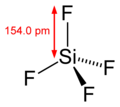 Silicon tetrafluoride 2D dimensions

