African elephant: Difference between revisions
CSV import |
CSV import |
||
| Line 1: | Line 1: | ||
== African Elephant == | |||
The '''African elephant''' (''Loxodonta'') is a genus comprising two living elephant species, the | The '''African elephant''' (''Loxodonta'') is a genus comprising two living elephant species, the African bush elephant (''Loxodonta africana'') and the smaller African forest elephant (''Loxodonta cyclotis''). They are the largest land animals on Earth and are found in various habitats across Africa. | ||
==Taxonomy== | == Taxonomy and Evolution == | ||
The genus ''Loxodonta'' is part of the family [[Elephantidae]], which also includes the [[Asian elephant]] and the extinct [[mammoth]]s. The African elephant is divided into two species: | |||
* '''African bush elephant''' (''Loxodonta africana'') | |||
* '''African forest elephant''' (''Loxodonta cyclotis'') | |||
The evolutionary history of elephants is complex, with many extinct relatives such as ''[[Palaeoloxodon]]'' and ''[[Mammuthus]]''. | |||
== | == Physical Characteristics == | ||
African elephants are distinguished by their large ears, which help to dissipate heat, and their trunk, which is a versatile appendage used for feeding, drinking, and social interactions. The bush elephant is larger than the forest elephant, with males reaching up to 4 meters in height and weighing up to 7,000 kg. | |||
African elephants are | |||
==Related | === Skull and Dentition === | ||
* [[ | |||
* [[ | The skull of the African elephant is large and houses a complex set of teeth. Elephants have a unique dental structure with large molars that are replaced several times throughout their life. The molar of an adult African elephant is adapted for grinding tough vegetation. | ||
* [[ | |||
* [[ | == Behavior and Ecology == | ||
African elephants are highly social animals, living in matriarchal family groups. They communicate through vocalizations, body language, and seismic signals. Elephants play a crucial role in their ecosystems by modifying habitats and dispersing seeds. | |||
== Conservation == | |||
Both species of African elephants are threatened by habitat loss and poaching for their ivory. Conservation efforts focus on habitat protection, anti-poaching measures, and reducing human-elephant conflict. | |||
== Related Pages == | |||
* [[Asian elephant]] | |||
* [[Mammoth]] | |||
* [[Palaeoloxodon]] | |||
* [[Elephantidae]] | |||
== Gallery == | |||
<gallery> | <gallery> | ||
African_Elephant_(Loxodonta_africana)_male_(17289351322).jpg|African bush elephant | |||
Loxodontacyclotis.jpg|African forest elephant | Loxodontacyclotis.jpg|African forest elephant | ||
Loxodonta_africana-cyclotis_skulls_PZSL.png|Skulls of African bush and forest elephants | Loxodonta_africana-cyclotis_skulls_PZSL.png|Skulls of African bush and forest elephants | ||
African_bush_elephant_skeleton.jpg|Skeleton of an African bush elephant | African_bush_elephant_skeleton.jpg|Skeleton of an African bush elephant | ||
Elephas_africanus_-_1700-1880_-_Print_-_Iconographia_Zoologica_-_(white_background).jpg|Historical illustration of an African elephant | Elephas_africanus_-_1700-1880_-_Print_-_Iconographia_Zoologica_-_(white_background).jpg|Historical illustration of an African elephant | ||
Palaeoloxodon_namadicus-bpk_(cropped).jpg|''Palaeoloxodon namadicus'' | |||
Indian_elephant_white_background.jpg|Asian elephant for comparison | |||
Mammuthus_trogontherii122DB.jpg|''Mammuthus trogontherii'' | |||
Palaeoloxodon_phylogeny.svg|Phylogeny of ''Palaeoloxodon'' | |||
African_Bush_Elephant_Skull.jpg|Skull of an African bush elephant | |||
Loxodonta_africana_-_Molar_of_an_adult.JPG|Molar of an adult African elephant | |||
</gallery> | </gallery> | ||
[[Category:Elephants]] | [[Category:Elephants]] | ||
[[Category:Mammals of Africa]] | [[Category:Mammals of Africa]] | ||
Revision as of 21:47, 11 February 2025
African Elephant
The African elephant (Loxodonta) is a genus comprising two living elephant species, the African bush elephant (Loxodonta africana) and the smaller African forest elephant (Loxodonta cyclotis). They are the largest land animals on Earth and are found in various habitats across Africa.
Taxonomy and Evolution
The genus Loxodonta is part of the family Elephantidae, which also includes the Asian elephant and the extinct mammoths. The African elephant is divided into two species:
- African bush elephant (Loxodonta africana)
- African forest elephant (Loxodonta cyclotis)
The evolutionary history of elephants is complex, with many extinct relatives such as Palaeoloxodon and Mammuthus.
Physical Characteristics
African elephants are distinguished by their large ears, which help to dissipate heat, and their trunk, which is a versatile appendage used for feeding, drinking, and social interactions. The bush elephant is larger than the forest elephant, with males reaching up to 4 meters in height and weighing up to 7,000 kg.
Skull and Dentition
The skull of the African elephant is large and houses a complex set of teeth. Elephants have a unique dental structure with large molars that are replaced several times throughout their life. The molar of an adult African elephant is adapted for grinding tough vegetation.
Behavior and Ecology
African elephants are highly social animals, living in matriarchal family groups. They communicate through vocalizations, body language, and seismic signals. Elephants play a crucial role in their ecosystems by modifying habitats and dispersing seeds.
Conservation
Both species of African elephants are threatened by habitat loss and poaching for their ivory. Conservation efforts focus on habitat protection, anti-poaching measures, and reducing human-elephant conflict.
Related Pages
Gallery
-
 African bush elephant
 -
 African forest elephant
 -
 Skulls of African bush and forest elephants
 -
 Skeleton of an African bush elephant
 -
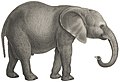 Historical illustration of an African elephant
 -
 Palaeoloxodon namadicus
 -
 Asian elephant for comparison
 -
 Mammuthus trogontherii
 -
 Phylogeny of Palaeoloxodon
 -
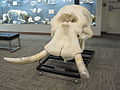 Skull of an African bush elephant
 -
 Molar of an adult African elephant
_male_(17289351322).jpg)


.jpg)
.jpg)


