Araucaria bidwillii: Difference between revisions
CSV import Tags: mobile edit mobile web edit |
CSV import |
||
| Line 1: | Line 1: | ||
== Antimony Trioxide == | |||
[[File:Antimony_trioxide.jpg|thumb|Antimony trioxide powder]] | |||
'''Antimony trioxide''' is a chemical compound with the formula Sb<sub>2</sub>O<sub>3</sub>. It is the most important commercial compound of [[antimony]]. The compound is found in nature as the minerals [[senarmontite]] and [[valentinite]]. | |||
''' | |||
== | == Structure == | ||
Antimony trioxide exists in two crystalline forms: cubic and orthorhombic. The cubic form is known as senarmontite, while the orthorhombic form is known as valentinite. In both forms, the antimony atoms are in a +3 oxidation state, and the oxygen atoms are in a -2 oxidation state. | |||
== | === Senarmontite === | ||
[[File:Sb4O6-molecule-from-senarmontite-xtal-2004-3D-balls-B.png|thumb|left|Molecular structure of senarmontite]] | |||
Senarmontite has a cubic crystal structure. In this form, the antimony atoms are coordinated to three oxygen atoms, forming a pyramidal shape. This structure is similar to that of arsenic trioxide. | |||
== | === Valentinite === | ||
[[File:Antimony(III)-oxide-valentinite-xtal-2004-3D-balls.png|thumb|left|Molecular structure of valentinite]] | |||
Valentinite has an orthorhombic crystal structure. In this form, the antimony atoms are also coordinated to three oxygen atoms, but the arrangement is different from that in senarmontite, leading to a different crystal symmetry. | |||
[[ | == Production == | ||
[[Category: | Antimony trioxide is produced by roasting antimony sulfide ores or by oxidizing antimony metal. The process involves the reaction of antimony with oxygen to form the trioxide: | ||
[[Category: | |||
: 4 Sb + 3 O<sub>2</sub> _ 2 Sb<sub>2</sub>O<sub>3</sub> | |||
The product is then purified by sublimation. | |||
== Applications == | |||
Antimony trioxide is used as a flame retardant in plastics, textiles, and electronics. It is also used as a catalyst in the production of [[polyethylene terephthalate]] (PET) and as an opacifying agent in the manufacture of glass and ceramics. | |||
== Health and Safety == | |||
Antimony trioxide is considered a potential occupational carcinogen. Exposure to antimony trioxide can occur in industrial settings, and it is important to follow safety guidelines to minimize exposure. | |||
== Related Pages == | |||
* [[Antimony]] | |||
* [[Senarmontite]] | |||
* [[Valentinite]] | |||
* [[Flame retardant]] | |||
== Gallery == | |||
<gallery> | |||
File:Antimony(III)-oxide-senarmontite-xtal-2004-3D-balls.png|3D structure of senarmontite | |||
File:Antimony(III)-oxide-valentinite-xtal-2004-3D-balls.png|3D structure of valentinite | |||
</gallery> | |||
[[Category:Antimony compounds]] | |||
[[Category:Oxides]] | |||
Revision as of 19:19, 11 February 2025
Antimony Trioxide

Antimony trioxide is a chemical compound with the formula Sb2O3. It is the most important commercial compound of antimony. The compound is found in nature as the minerals senarmontite and valentinite.
Structure
Antimony trioxide exists in two crystalline forms: cubic and orthorhombic. The cubic form is known as senarmontite, while the orthorhombic form is known as valentinite. In both forms, the antimony atoms are in a +3 oxidation state, and the oxygen atoms are in a -2 oxidation state.
Senarmontite

Senarmontite has a cubic crystal structure. In this form, the antimony atoms are coordinated to three oxygen atoms, forming a pyramidal shape. This structure is similar to that of arsenic trioxide.
Valentinite
-oxide-valentinite-xtal-2004-3D-balls.png)
Valentinite has an orthorhombic crystal structure. In this form, the antimony atoms are also coordinated to three oxygen atoms, but the arrangement is different from that in senarmontite, leading to a different crystal symmetry.
Production
Antimony trioxide is produced by roasting antimony sulfide ores or by oxidizing antimony metal. The process involves the reaction of antimony with oxygen to form the trioxide:
- 4 Sb + 3 O2 _ 2 Sb2O3
The product is then purified by sublimation.
Applications
Antimony trioxide is used as a flame retardant in plastics, textiles, and electronics. It is also used as a catalyst in the production of polyethylene terephthalate (PET) and as an opacifying agent in the manufacture of glass and ceramics.
Health and Safety
Antimony trioxide is considered a potential occupational carcinogen. Exposure to antimony trioxide can occur in industrial settings, and it is important to follow safety guidelines to minimize exposure.
Related Pages
Gallery
-
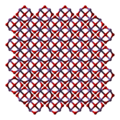 3D structure of senarmontite
 -
 3D structure of valentinite
-oxide-senarmontite-xtal-2004-3D-balls.png)
