Armstrong limit: Difference between revisions
CSV import Tags: mobile edit mobile web edit |
CSV import |
||
| Line 1: | Line 1: | ||
{{Short description|Minimum distance from the center to the side of a regular polygon}} | |||
The '''apothem''' of a regular polygon is the distance from the center to the midpoint of one of its sides. It is a key concept in geometry, particularly in the study of regular polygons, and is used in various calculations, including the area of the polygon. | |||
The | |||
== | ==Definition== | ||
In a regular polygon, all sides and angles are equal. The apothem is the perpendicular distance from the center of the polygon to one of its sides. It can also be considered as the radius of the inscribed circle (incircle) of the polygon. | |||
== | ==Properties== | ||
The apothem is an important element in determining the area of a regular polygon. The formula for the area \(A\) of a regular polygon with \(n\) sides, each of length \(s\), and apothem \(a\) is given by: | |||
\[ | |||
A = \frac{1}{2} \times n \times s \times a | |||
\] | |||
This formula can also be expressed in terms of the perimeter \(P\) of the polygon: | |||
{{ | \[ | ||
A = \frac{1}{2} \times P \times a | |||
\] | |||
[[ | ==Calculation== | ||
[[ | The apothem can be calculated if the side length \(s\) and the number of sides \(n\) of the regular polygon are known. The formula for the apothem \(a\) is: | ||
[[Category: | |||
\[ | |||
a = \frac{s}{2 \tan(\pi/n)} | |||
\] | |||
This formula arises from the fact that the apothem is the adjacent side of a right triangle formed by the radius of the circumscribed circle, the apothem itself, and half of a side of the polygon. | |||
==Applications== | |||
The apothem is used in various applications, including: | |||
* Calculating the area of regular polygons. | |||
* Determining the radius of the inscribed circle. | |||
* Architectural design and construction, where regular polygons are used in tiling and other patterns. | |||
==Examples== | |||
For a regular hexagon with side length \(s\), the apothem can be calculated using the formula: | |||
\[ | |||
a = \frac{s}{2 \tan(\pi/6)} = \frac{s}{\sqrt{3}} | |||
\] | |||
This is because a regular hexagon can be divided into six equilateral triangles, and the apothem is the height of one of these triangles. | |||
==Related pages== | |||
* [[Regular polygon]] | |||
* [[Circumscribed circle]] | |||
* [[Inscribed circle]] | |||
* [[Perimeter]] | |||
==Gallery== | |||
<gallery> | |||
File:Apothem_of_hexagon.svg|Diagram showing the apothem of a hexagon | |||
</gallery> | |||
[[Category:Geometry]] | |||
Revision as of 18:48, 11 February 2025
Minimum distance from the center to the side of a regular polygon
The apothem of a regular polygon is the distance from the center to the midpoint of one of its sides. It is a key concept in geometry, particularly in the study of regular polygons, and is used in various calculations, including the area of the polygon.
Definition
In a regular polygon, all sides and angles are equal. The apothem is the perpendicular distance from the center of the polygon to one of its sides. It can also be considered as the radius of the inscribed circle (incircle) of the polygon.
Properties
The apothem is an important element in determining the area of a regular polygon. The formula for the area \(A\) of a regular polygon with \(n\) sides, each of length \(s\), and apothem \(a\) is given by:
\[ A = \frac{1}{2} \times n \times s \times a \]
This formula can also be expressed in terms of the perimeter \(P\) of the polygon:
\[ A = \frac{1}{2} \times P \times a \]
Calculation
The apothem can be calculated if the side length \(s\) and the number of sides \(n\) of the regular polygon are known. The formula for the apothem \(a\) is:
\[ a = \frac{s}{2 \tan(\pi/n)} \]
This formula arises from the fact that the apothem is the adjacent side of a right triangle formed by the radius of the circumscribed circle, the apothem itself, and half of a side of the polygon.
Applications
The apothem is used in various applications, including:
- Calculating the area of regular polygons.
- Determining the radius of the inscribed circle.
- Architectural design and construction, where regular polygons are used in tiling and other patterns.
Examples
For a regular hexagon with side length \(s\), the apothem can be calculated using the formula:
\[ a = \frac{s}{2 \tan(\pi/6)} = \frac{s}{\sqrt{3}} \]
This is because a regular hexagon can be divided into six equilateral triangles, and the apothem is the height of one of these triangles.
Related pages
Gallery
-
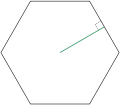 Diagram showing the apothem of a hexagon

