Underwater work: Difference between revisions
CSV import |
CSV import |
||
| Line 1: | Line 1: | ||
== Underwater Work == | |||
Underwater work encompasses a variety of tasks performed beneath the surface of water bodies, including oceans, seas, lakes, and rivers. This type of work is essential for various industries such as [[construction]], [[oil and gas]], [[marine biology]], and [[archaeology]]. Underwater work requires specialized skills and equipment to ensure safety and efficiency. | |||
== Underwater | === Types of Underwater Work === | ||
== Underwater | ==== Underwater Construction ==== | ||
Underwater construction involves building or repairing structures below the water surface. This includes the construction of [[bridges]], [[dams]], [[offshore platforms]], and [[underwater tunnels]]. Divers and remotely operated vehicles (ROVs) are often used to perform tasks such as welding, cutting, and assembly of components. | |||
== Underwater | ==== Underwater Welding and Cutting ==== | ||
[[ | Underwater welding and cutting are critical skills in underwater construction and repair. Techniques such as [[oxy-arc cutting]] and [[wet welding]] are commonly used. These processes require specialized equipment and training to handle the challenges posed by the underwater environment. | ||
== | ==== Salvage Operations ==== | ||
Salvage operations involve the recovery of sunken vessels, aircraft, and other objects from the seabed. These operations can be complex and require careful planning and execution to prevent further damage to the objects being salvaged. | |||
== | ==== Inspection and Maintenance ==== | ||
* [[ | Regular inspection and maintenance of underwater structures are crucial to ensure their integrity and safety. This includes the inspection of [[ship hulls]], [[pipelines]], and [[subsea cables]]. Techniques such as [[ultrasonic testing]] and [[magnetic particle inspection]] are used to detect defects and corrosion. | ||
* [[ | |||
* [[ | ==== Scientific Research ==== | ||
* [[ | Underwater work is also vital for scientific research, including marine biology and archaeology. Researchers conduct underwater surveys, collect samples, and study marine ecosystems to gain insights into underwater environments and their inhabitants. | ||
=== Equipment Used in Underwater Work === | |||
Underwater work requires a range of specialized equipment, including: | |||
* '''Diving Equipment''': Scuba gear, surface-supplied diving systems, and diving bells are used to allow divers to work underwater safely. | |||
* '''ROVs and AUVs''': Remotely operated vehicles (ROVs) and autonomous underwater vehicles (AUVs) are used for tasks that are too dangerous or difficult for human divers. | |||
* '''Underwater Tools''': Tools such as underwater welders, cutting torches, and hydraulic tools are designed to function effectively in submerged conditions. | |||
=== Safety Considerations === | |||
Safety is paramount in underwater work due to the inherent risks involved. Proper training, equipment maintenance, and adherence to safety protocols are essential to minimize the risk of accidents. Divers must be aware of hazards such as decompression sickness, entanglement, and equipment failure. | |||
== Related Pages == | |||
* [[Commercial diving]] | |||
* [[Marine engineering]] | |||
* [[Subsea engineering]] | |||
* [[Underwater archaeology]] | |||
== References == | == References == | ||
< | * "Underwater Work." Wikipedia, The Free Encyclopedia. https://en.wikipedia.org/wiki/Underwater_work | ||
* "Commercial Diving." Wikipedia, The Free Encyclopedia. https://en.wikipedia.org/wiki/Commercial_diving | |||
== Gallery == | |||
<gallery> | |||
File:Underwater_oxy-arc_cutting.jpg|Underwater oxy-arc cutting | |||
File:Sailor_performs_an_underwater_fillet_weld_in_a_training_pool_at_the_ROK_engineering_school_._(25226373464).jpg|Underwater welding training | |||
File:970216-N-3093M-002_Underwater_Construction_Training.jpg|Underwater construction training | |||
File:Arbeitstaucher_bei_Industrietaucharbeiten.jpg|Industrial diving work | |||
File:Coral-drilling_hg.jpg|Coral drilling | |||
File:Buzos_con_cemento.jpg|Divers working with cement | |||
File:ROV_working_on_a_subsea_structure.jpg|ROV working on a subsea structure | |||
File:US_Navy_011105-N-3093M-011_Navy_deep_sea_diver.jpg|Navy deep sea diver | |||
File:Ultrasonidos.jpg|Ultrasonic inspection | |||
File:Inspeccion_mediante_corrientes.jpg|Inspection using currents | |||
File:US_Navy_080624-N-5329L-290_U.S._Army_Staff_Sergeant_David_Gills,_assigned_to_the_86th_Engineering_Dive_Team,_attaches_a_line_on_a_wire_rope_that_is_attached_to_the_sunken_former_Soviet_submarine_Juliett_484.jpg|Attaching a line to a sunken submarine | |||
File:US_Navy_051206-N-0879R-005_A_U.S._Navy_diver_uses_a_scrubber_to_clean_the_hull_of_the_Los_Angeles-class_fast_attack_submarine_USS_Key_West_(SSN_722).jpg|Cleaning a submarine hull | |||
File:US_Navy_080724-N-3093M-019_Senior_Chief_Diver_Billy_Gilbert,_assigned_to_Mobile_Diving_and_Salvage_Unit_(MDSU)_2,_uses_a_pipe_wrench_to_remove_a_damaged_propeller_on_a_small_patrol_boat.jpg|Removing a damaged propeller | |||
File:US_Navy_110520-N-VF350-023_Navy_Diver_2nd_Class_Joshua_Westman_sucks_sand_off_the_bottom_of_the_ocean_during_a_Joint_POW-MIA_Accounting_Command_(JP.jpg|Sucking sand off the ocean floor | |||
File:US_Navy_110608-N-XD935-079_Navy_Diver_2nd_Class_Justin_McMillen_holds_the_lift_line_as_Ordinary_Seaman_Romando_Thomas_fills_air_into_a_lift_bag.jpg|Filling a lift bag with air | |||
</gallery> | |||
[[Category:Underwater work]] | [[Category:Underwater work]] | ||
Revision as of 01:22, 10 February 2025
Underwater Work
Underwater work encompasses a variety of tasks performed beneath the surface of water bodies, including oceans, seas, lakes, and rivers. This type of work is essential for various industries such as construction, oil and gas, marine biology, and archaeology. Underwater work requires specialized skills and equipment to ensure safety and efficiency.
Types of Underwater Work
Underwater Construction
Underwater construction involves building or repairing structures below the water surface. This includes the construction of bridges, dams, offshore platforms, and underwater tunnels. Divers and remotely operated vehicles (ROVs) are often used to perform tasks such as welding, cutting, and assembly of components.
Underwater Welding and Cutting
Underwater welding and cutting are critical skills in underwater construction and repair. Techniques such as oxy-arc cutting and wet welding are commonly used. These processes require specialized equipment and training to handle the challenges posed by the underwater environment.
Salvage Operations
Salvage operations involve the recovery of sunken vessels, aircraft, and other objects from the seabed. These operations can be complex and require careful planning and execution to prevent further damage to the objects being salvaged.
Inspection and Maintenance
Regular inspection and maintenance of underwater structures are crucial to ensure their integrity and safety. This includes the inspection of ship hulls, pipelines, and subsea cables. Techniques such as ultrasonic testing and magnetic particle inspection are used to detect defects and corrosion.
Scientific Research
Underwater work is also vital for scientific research, including marine biology and archaeology. Researchers conduct underwater surveys, collect samples, and study marine ecosystems to gain insights into underwater environments and their inhabitants.
Equipment Used in Underwater Work
Underwater work requires a range of specialized equipment, including:
- Diving Equipment: Scuba gear, surface-supplied diving systems, and diving bells are used to allow divers to work underwater safely.
- ROVs and AUVs: Remotely operated vehicles (ROVs) and autonomous underwater vehicles (AUVs) are used for tasks that are too dangerous or difficult for human divers.
- Underwater Tools: Tools such as underwater welders, cutting torches, and hydraulic tools are designed to function effectively in submerged conditions.
Safety Considerations
Safety is paramount in underwater work due to the inherent risks involved. Proper training, equipment maintenance, and adherence to safety protocols are essential to minimize the risk of accidents. Divers must be aware of hazards such as decompression sickness, entanglement, and equipment failure.
Related Pages
References
- "Underwater Work." Wikipedia, The Free Encyclopedia. https://en.wikipedia.org/wiki/Underwater_work
- "Commercial Diving." Wikipedia, The Free Encyclopedia. https://en.wikipedia.org/wiki/Commercial_diving
Gallery
-
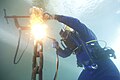 Underwater oxy-arc cutting
 -
 Underwater welding training
 -
 Underwater construction training
 -
 Industrial diving work
 -
Coral drilling
-
Divers working with cement
-
ROV working on a subsea structure
-
Navy deep sea diver
-
Ultrasonic inspection
-
Inspection using currents
-
Attaching a line to a sunken submarine
-
Cleaning a submarine hull
-
Removing a damaged propeller
-
Sucking sand off the ocean floor
-
Filling a lift bag with air

.jpg)


.jpg)
_2,_uses_a_pipe_wrench_to_remove_a_damaged_propeller_on_a_small_patrol_boat.jpg)

