Ulnar nerve: Difference between revisions
CSV import |
CSV import |
||
| Line 1: | Line 1: | ||
== Ulnar Nerve == | |||
The ''' | The '''ulnar nerve''' is a major peripheral nerve of the upper limb. It is one of the five main nerves originating from the [[brachial plexus]]. The ulnar nerve is responsible for the innervation of the muscles in the anterior compartment of the forearm and the intrinsic muscles of the hand. It also provides sensory innervation to the skin of the hand. | ||
== Anatomy == | == Anatomy == | ||
The ulnar nerve | The ulnar nerve arises from the [[medial cord]] of the brachial plexus, carrying fibers from the C8 and T1 nerve roots. It travels down the arm, passing posterior to the [[medial epicondyle]] of the humerus, where it is superficial and vulnerable to injury. This location is commonly referred to as the "funny bone." | ||
In the forearm, the ulnar nerve travels between the [[flexor carpi ulnaris]] and the [[flexor digitorum profundus]] muscles. It supplies motor branches to these muscles and continues into the hand. | |||
== Function == | |||
The ulnar nerve provides motor innervation to the following muscles: | |||
* In the forearm: [[Flexor carpi ulnaris]] and the medial half of the [[flexor digitorum profundus]]. | |||
* In the hand: [[Hypothenar muscles]], [[adductor pollicis]], [[interossei]], and the medial two [[lumbricals]]. | |||
* [[Cubital tunnel]] | Sensory innervation is provided to the skin over the medial one and a half fingers and the associated palm area. | ||
* [[Guyon's canal]] | |||
* [[ | == Clinical Significance == | ||
=== Ulnar Nerve Entrapment === | |||
Ulnar nerve entrapment can occur at several sites, most commonly at the elbow (cubital tunnel syndrome) and the wrist (Guyon's canal syndrome). Symptoms include numbness, tingling, and weakness in the hand. | |||
=== Guyon's Canal Syndrome === | |||
[[Guyon's canal syndrome]] is caused by compression of the ulnar nerve as it passes through Guyon's canal at the wrist. It can lead to weakness of the intrinsic muscles of the hand and sensory loss in the ulnar distribution. | |||
== Related Pages == | |||
* [[Brachial plexus]] | |||
* [[Cubital tunnel syndrome]] | |||
* [[Guyon's canal syndrome]] | |||
* [[Peripheral nerve injury]] | |||
== References == | == References == | ||
< | * Standring, S. (2016). Gray's Anatomy: The Anatomical Basis of Clinical Practice. 41st Edition. Elsevier. | ||
* Moore, K. L., Dalley, A. F., & Agur, A. M. R. (2013). Clinically Oriented Anatomy. 7th Edition. Lippincott Williams & Wilkins. | |||
== Gallery == | |||
<gallery> | |||
File:Brachial_plexus_2.svg|Diagram of the brachial plexus. | |||
File:Nerves_of_the_left_upper_extremity.gif|Nerves of the left upper extremity. | |||
File:Guyon_canal_syndrome_zones.svg|Zones of Guyon's canal syndrome. | |||
File:Gray812and814.svg|Anatomy of the ulnar nerve. | |||
File:Brachial_plexus_color.svg|Color-coded brachial plexus. | |||
File:Gray413.png|Muscles of the forearm. | |||
File:Gray417.png|Superficial muscles of the forearm. | |||
File:Gray421.png|Deep muscles of the forearm. | |||
File:Carpal-Tunnel.svg|Carpal tunnel anatomy. | |||
File:Gray528.png|Bones of the hand. | |||
File:Gray809.png|Nerves of the hand. | |||
File:Gray1235.png|Cross-section of the forearm. | |||
File:Gray1236.png|Cross-section of the wrist. | |||
File:Slide4t.JPG|Clinical image of ulnar nerve. | |||
File:Slide4zzz.JPG|Surgical view of the ulnar nerve. | |||
File:Slide3bbbb.JPG|Ulnar nerve in the forearm. | |||
File:Slide2hhhh.JPG|Ulnar nerve at the elbow. | |||
File:Slide10WWW.JPG|Ulnar nerve in the hand. | |||
File:Slide1ecc.JPG|Ulnar nerve compression. | |||
</gallery> | |||
[[Category:Peripheral nervous system]] | [[Category:Peripheral nervous system]] | ||
Revision as of 01:22, 10 February 2025
Ulnar Nerve
The ulnar nerve is a major peripheral nerve of the upper limb. It is one of the five main nerves originating from the brachial plexus. The ulnar nerve is responsible for the innervation of the muscles in the anterior compartment of the forearm and the intrinsic muscles of the hand. It also provides sensory innervation to the skin of the hand.
Anatomy
The ulnar nerve arises from the medial cord of the brachial plexus, carrying fibers from the C8 and T1 nerve roots. It travels down the arm, passing posterior to the medial epicondyle of the humerus, where it is superficial and vulnerable to injury. This location is commonly referred to as the "funny bone."
In the forearm, the ulnar nerve travels between the flexor carpi ulnaris and the flexor digitorum profundus muscles. It supplies motor branches to these muscles and continues into the hand.
Function
The ulnar nerve provides motor innervation to the following muscles:
- In the forearm: Flexor carpi ulnaris and the medial half of the flexor digitorum profundus.
- In the hand: Hypothenar muscles, adductor pollicis, interossei, and the medial two lumbricals.
Sensory innervation is provided to the skin over the medial one and a half fingers and the associated palm area.
Clinical Significance
Ulnar Nerve Entrapment
Ulnar nerve entrapment can occur at several sites, most commonly at the elbow (cubital tunnel syndrome) and the wrist (Guyon's canal syndrome). Symptoms include numbness, tingling, and weakness in the hand.
Guyon's Canal Syndrome
Guyon's canal syndrome is caused by compression of the ulnar nerve as it passes through Guyon's canal at the wrist. It can lead to weakness of the intrinsic muscles of the hand and sensory loss in the ulnar distribution.
Related Pages
References
- Standring, S. (2016). Gray's Anatomy: The Anatomical Basis of Clinical Practice. 41st Edition. Elsevier.
- Moore, K. L., Dalley, A. F., & Agur, A. M. R. (2013). Clinically Oriented Anatomy. 7th Edition. Lippincott Williams & Wilkins.
Gallery
-
Diagram of the brachial plexus.
-
Nerves of the left upper extremity.
-
Zones of Guyon's canal syndrome.
-
Anatomy of the ulnar nerve.
-
Color-coded brachial plexus.
-
Muscles of the forearm.
-
Superficial muscles of the forearm.
-
Deep muscles of the forearm.
-
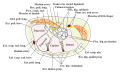 Carpal tunnel anatomy.
 -
 Bones of the hand.
 -
Nerves of the hand.
-
 Cross-section of the forearm.
 -
Cross-section of the wrist.
-
Clinical image of ulnar nerve.
-
Surgical view of the ulnar nerve.
-
Ulnar nerve in the forearm.
-
Ulnar nerve at the elbow.
-
Ulnar nerve in the hand.
-
Ulnar nerve compression.


