Trigonometric functions: Difference between revisions
CSV import |
CSV import |
||
| Line 1: | Line 1: | ||
== Trigonometric Functions == | |||
Trigonometric functions are fundamental mathematical functions that relate the angles of a triangle to the lengths of its sides. They are widely used in various fields such as [[mathematics]], [[physics]], [[engineering]], and [[computer science]]. The primary trigonometric functions are the sine, cosine, and tangent, which are defined for angles in a right triangle or on the unit circle. | |||
Trigonometric functions are | |||
=== Definitions === | |||
The six main trigonometric functions are: | |||
* '''Sine (sin)''': In a right triangle, the sine of an angle is the ratio of the length of the opposite side to the hypotenuse. | |||
* '''Cosine (cos)''': The cosine of an angle is the ratio of the length of the adjacent side to the hypotenuse. | |||
* '''Tangent (tan)''': The tangent of an angle is the ratio of the sine to the cosine, or equivalently, the opposite side to the adjacent side. | |||
* '''Cosecant (csc)''': The cosecant is the reciprocal of the sine. | |||
* '''Secant (sec)''': The secant is the reciprocal of the cosine. | |||
* '''Cotangent (cot)''': The cotangent is the reciprocal of the tangent. | |||
== | === Unit Circle === | ||
The unit circle is a circle with a radius of one centered at the origin of the coordinate plane. It is a fundamental tool in trigonometry, allowing the extension of trigonometric functions to all real numbers. The angle in the unit circle is measured from the positive x-axis, and the coordinates of a point on the unit circle are \((\cos \theta, \sin \theta)\). | |||
== | [[File:Unit_Circle_Definitions_of_Six_Trigonometric_Functions.svg|thumb|right|Unit circle definitions of trigonometric functions]] | ||
Trigonometric functions | |||
=== Periodicity and Symmetry === | |||
Trigonometric functions are periodic, meaning they repeat their values in regular intervals. The sine and cosine functions have a period of \(2\pi\), while the tangent and cotangent have a period of \(\pi\). These functions also exhibit symmetry properties: | |||
* '''Even functions''': Cosine and secant are even functions, meaning \(\cos(-\theta) = \cos(\theta)\). | |||
* '''Odd functions''': Sine, tangent, cosecant, and cotangent are odd functions, meaning \(\sin(-\theta) = -\sin(\theta)\). | |||
=== Graphs === | |||
The graphs of trigonometric functions are wave-like and exhibit periodic behavior. The sine and cosine functions produce smooth, continuous waves, while the tangent function has vertical asymptotes and repeats every \(\pi\) radians. | |||
[[File:Periodic_sine.svg|thumb|right|Graph of the sine function]] | |||
=== Applications === | |||
Trigonometric functions are used in various applications, including: | |||
* '''Wave analysis''': Modeling sound waves, light waves, and other periodic phenomena. | |||
* '''Engineering''': Calculating forces, angles, and distances in mechanical and civil engineering. | |||
* '''Astronomy''': Determining the positions of celestial bodies. | |||
* '''Computer graphics''': Rotating and transforming objects in 3D space. | |||
=== Related Functions === | |||
Trigonometric functions are closely related to the exponential function through Euler's formula, which connects complex exponentials to trigonometric functions: | |||
\[ e^{i\theta} = \cos \theta + i\sin \theta \] | |||
=== Related Pages === | |||
* [[Trigonometry]] | * [[Trigonometry]] | ||
* [[Unit circle]] | * [[Unit circle]] | ||
* [[Fourier series]] | |||
* [[Euler's formula]] | * [[Euler's formula]] | ||
== Gallery == | |||
<gallery> | |||
File:Academ_Base_of_trigonometry.svg|Base of trigonometry | |||
File:TrigonometryTriangle.svg|Trigonometry triangle | |||
File:TrigFunctionDiagram.svg|Diagram of trigonometric functions | |||
File:Circle-trig6.svg|Circle with trigonometric functions | |||
File:Unit_Circle_Definitions_of_Six_Trigonometric_Functions.svg|Unit circle definitions | |||
File:trigonometric_function_quadrant_sign.svg|Quadrant signs of trigonometric functions | |||
File:Trigonometric_functions.svg|Trigonometric functions | |||
File:Unit_circle_angles_color.svg|Unit circle angles | |||
File:Taylorsine.svg|Taylor series of sine | |||
File:Taylor_cos.gif|Taylor series of cosine | |||
File:Taylorreihenentwicklung_des_Kosinus.svg|Taylor series expansion of cosine | |||
File:Sinus_und_Kosinus_am_Einheitskreis_3.svg|Sine and cosine on the unit circle | |||
File:Trig-sin.png|Graph of sine | |||
File:Trig-cos.png|Graph of cosine | |||
File:Trig-tan.png|Graph of tangent | |||
File:Trig-cot.png|Graph of cotangent | |||
File:Trig-sec.png|Graph of secant | |||
File:Trig-csc.png|Graph of cosecant | |||
File:Lissajous_curve_5by4.svg|Lissajous curve | |||
File:Synthesis_square.gif|Square wave synthesis | |||
File:Sawtooth_Fourier_Animation.gif|Sawtooth Fourier animation | |||
</gallery> | |||
{{Trigonometry}} | |||
[[Category:Trigonometry]] | [[Category:Trigonometry]] | ||
Revision as of 01:08, 10 February 2025
Trigonometric Functions
Trigonometric functions are fundamental mathematical functions that relate the angles of a triangle to the lengths of its sides. They are widely used in various fields such as mathematics, physics, engineering, and computer science. The primary trigonometric functions are the sine, cosine, and tangent, which are defined for angles in a right triangle or on the unit circle.
Definitions
The six main trigonometric functions are:
- Sine (sin): In a right triangle, the sine of an angle is the ratio of the length of the opposite side to the hypotenuse.
- Cosine (cos): The cosine of an angle is the ratio of the length of the adjacent side to the hypotenuse.
- Tangent (tan): The tangent of an angle is the ratio of the sine to the cosine, or equivalently, the opposite side to the adjacent side.
- Cosecant (csc): The cosecant is the reciprocal of the sine.
- Secant (sec): The secant is the reciprocal of the cosine.
- Cotangent (cot): The cotangent is the reciprocal of the tangent.
Unit Circle
The unit circle is a circle with a radius of one centered at the origin of the coordinate plane. It is a fundamental tool in trigonometry, allowing the extension of trigonometric functions to all real numbers. The angle in the unit circle is measured from the positive x-axis, and the coordinates of a point on the unit circle are \((\cos \theta, \sin \theta)\).
Periodicity and Symmetry
Trigonometric functions are periodic, meaning they repeat their values in regular intervals. The sine and cosine functions have a period of \(2\pi\), while the tangent and cotangent have a period of \(\pi\). These functions also exhibit symmetry properties:
- Even functions: Cosine and secant are even functions, meaning \(\cos(-\theta) = \cos(\theta)\).
- Odd functions: Sine, tangent, cosecant, and cotangent are odd functions, meaning \(\sin(-\theta) = -\sin(\theta)\).
Graphs
The graphs of trigonometric functions are wave-like and exhibit periodic behavior. The sine and cosine functions produce smooth, continuous waves, while the tangent function has vertical asymptotes and repeats every \(\pi\) radians.
Applications
Trigonometric functions are used in various applications, including:
- Wave analysis: Modeling sound waves, light waves, and other periodic phenomena.
- Engineering: Calculating forces, angles, and distances in mechanical and civil engineering.
- Astronomy: Determining the positions of celestial bodies.
- Computer graphics: Rotating and transforming objects in 3D space.
Related Functions
Trigonometric functions are closely related to the exponential function through Euler's formula, which connects complex exponentials to trigonometric functions:
\[ e^{i\theta} = \cos \theta + i\sin \theta \]
Related Pages
Gallery
-
Base of trigonometry
-
Trigonometry triangle
-
Diagram of trigonometric functions
-
Circle with trigonometric functions
-
Unit circle definitions
-
Quadrant signs of trigonometric functions
-
Trigonometric functions
-
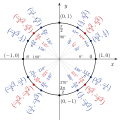 Unit circle angles
 -
 Taylor series of sine
 -
 Taylor series of cosine
 -
 Taylor series expansion of cosine
 -
 Sine and cosine on the unit circle
 -
 Graph of sine
 -
Graph of cosine
-
Graph of tangent
-
Graph of cotangent
-
Graph of secant
-
Graph of cosecant
-
Lissajous curve
-
Square wave synthesis
-
Sawtooth Fourier animation


