Urticaceae: Difference between revisions
CSV import Tags: mobile edit mobile web edit |
CSV import |
||
| Line 1: | Line 1: | ||
== Urticaceae == | |||
The '''Urticaceae''' | The '''Urticaceae''' family, commonly known as the nettle family, is a family of flowering plants. The family includes a variety of species, many of which are known for their stinging hairs. The family is part of the order [[Rosales]] and includes around 54 genera and 2,625 species. | ||
== Description == | == Description == | ||
Members of the Urticaceae family are | Members of the Urticaceae family are typically herbaceous plants, shrubs, or small trees. They are characterized by their opposite or alternate leaves, which are often serrated. Many species have stinging hairs that can cause skin irritation upon contact. The flowers are usually small and inconspicuous, often arranged in clusters. | ||
== | == Distribution == | ||
The Urticaceae family is | The Urticaceae family is cosmopolitan, found in a wide range of habitats from tropical to temperate regions. They are particularly diverse in tropical areas. | ||
== | == Notable Genera and Species == | ||
=== Urtica === | |||
The genus ''[[Urtica]]'' includes the well-known stinging nettles, such as ''[[Urtica dioica]]''. These plants are known for their stinging hairs that can cause a painful rash. | |||
=== Pilea === | |||
''[[Pilea]]'' is a large genus within the family, including species like ''Pilea cadierei'' (aluminum plant) and ''Pilea pumila'' (clearweed). | |||
=== Boehmeria === | |||
''[[Boehmeria]]'' includes species such as ''Boehmeria nivea'', commonly known as ramie, which is cultivated for its fiber. | |||
=== Parietaria === | |||
''[[Parietaria]]'' includes species like ''Parietaria judaica'', known as pellitory-of-the-wall, which is often found growing on walls and rocky areas. | |||
=== Dendrocnide === | |||
''[[Dendrocnide]]'' includes species such as ''Dendrocnide meyeniana'', known for its potent stinging hairs. | |||
== Uses == | == Uses == | ||
Many species | Many species in the Urticaceae family have economic importance. ''Urtica dioica'' is used in traditional medicine and as a food source. ''Boehmeria nivea'' is cultivated for its strong fiber, used in textiles. | ||
== | == Related Pages == | ||
* [[ | * [[Rosales]] | ||
* [[ | * [[Stinging plant]] | ||
* [[ | * [[Herbaceous plant]] | ||
== References == | == References == | ||
* Friis, I. (1989). "The Urticaceae: A systematic review." In: Kubitzki, K. (ed.), The Families and Genera of Vascular Plants. | |||
* Mabberley, D.J. (2008). "Mabberley's Plant-book: A Portable Dictionary of Plants, their Classifications, and Uses." | |||
== Gallery == | |||
<gallery> | |||
File:Urtica-dioica(Blueten).jpg|''Urtica dioica'' flowers | |||
File:Urtica_flowerdiagram.png|Diagram of ''Urtica'' flower | |||
File:PileaCadierei.jpg|''Pilea cadierei'' | |||
File:Pilea_pumila2.JPG|''Pilea pumila'' | |||
File:Poisonivy1.jpg|''Toxicodendron radicans'' (Poison ivy) | |||
File:Elatostema_umbellatum_2006.04.19_06.17.14-p4190208.jpg|''Elatostema umbellatum'' | |||
File:Brennnessel_1.JPG|''Urtica dioica'' | |||
File:Boehmeria_nivea_1.jpg|''Boehmeria nivea'' | |||
File:Parietaria_judaica_000.jpg|''Parietaria judaica'' | |||
File:Nettle.jpg|Common nettle | |||
</gallery> | |||
[[Category:Urticaceae]] | |||
Revision as of 00:42, 10 February 2025
Urticaceae
The Urticaceae family, commonly known as the nettle family, is a family of flowering plants. The family includes a variety of species, many of which are known for their stinging hairs. The family is part of the order Rosales and includes around 54 genera and 2,625 species.
Description
Members of the Urticaceae family are typically herbaceous plants, shrubs, or small trees. They are characterized by their opposite or alternate leaves, which are often serrated. Many species have stinging hairs that can cause skin irritation upon contact. The flowers are usually small and inconspicuous, often arranged in clusters.
Distribution
The Urticaceae family is cosmopolitan, found in a wide range of habitats from tropical to temperate regions. They are particularly diverse in tropical areas.
Notable Genera and Species
Urtica
The genus Urtica includes the well-known stinging nettles, such as Urtica dioica. These plants are known for their stinging hairs that can cause a painful rash.
Pilea
Pilea is a large genus within the family, including species like Pilea cadierei (aluminum plant) and Pilea pumila (clearweed).
Boehmeria
Boehmeria includes species such as Boehmeria nivea, commonly known as ramie, which is cultivated for its fiber.
Parietaria
Parietaria includes species like Parietaria judaica, known as pellitory-of-the-wall, which is often found growing on walls and rocky areas.
Dendrocnide
Dendrocnide includes species such as Dendrocnide meyeniana, known for its potent stinging hairs.
Uses
Many species in the Urticaceae family have economic importance. Urtica dioica is used in traditional medicine and as a food source. Boehmeria nivea is cultivated for its strong fiber, used in textiles.
Related Pages
References
- Friis, I. (1989). "The Urticaceae: A systematic review." In: Kubitzki, K. (ed.), The Families and Genera of Vascular Plants.
- Mabberley, D.J. (2008). "Mabberley's Plant-book: A Portable Dictionary of Plants, their Classifications, and Uses."
Gallery
-
 Urtica dioica flowers
 -
 Diagram of Urtica flower
 -
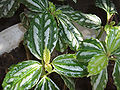 Pilea cadierei
 -
Pilea pumila
-
Toxicodendron radicans (Poison ivy)
-
Elatostema umbellatum
-
Urtica dioica
-
Boehmeria nivea
-
Parietaria judaica
-
Common nettle
.jpg)


