Toxicodendron radicans: Difference between revisions
CSV import |
CSV import |
||
| Line 1: | Line 1: | ||
'''Toxicodendron radicans''', commonly known as [[ | == Toxicodendron radicans == | ||
[[File:2014-10-29_13_43_39_Poison_Ivy_foliage_during_autumn_leaf_coloration_in_Ewing,_New_Jersey.JPG|Poison ivy foliage during autumn|thumb]] | |||
[[File:Poison_ivy_vine.jpg|Poison ivy vine|thumb|left]] | |||
[[File:Poison_Ivy_in_Perrot_State_Park.jpg|Poison ivy in Perrot State Park|thumb]] | |||
[[File:Toxicodendron_radicans_01.jpg|Close-up of poison ivy leaves|thumb|left]] | |||
[[File:Poison_ivy-roadside.jpg|Poison ivy growing by the roadside|thumb]] | |||
[[File:Poison_ivy_in_May_beside_Appalachian_Trail_in_Rockfish_Gap_VA_area_1.jpg|Poison ivy beside the Appalachian Trail|thumb]] | |||
'''Toxicodendron radicans''', commonly known as '''poison ivy''', is a species of flowering plant in the family [[Anacardiaceae]]. It is well-known for causing an itchy rash in most people who touch it. The plant is native to [[North America]] and is found in a variety of habitats, including forests, fields, and urban areas. | |||
== Description == | == Description == | ||
== Distribution and | Poison ivy is a deciduous plant that can grow as a shrub or a climbing vine. It is characterized by its compound leaves, which typically have three leaflets, hence the common saying "Leaves of three, let it be." The leaflets are variable in shape but often have a pointed tip and can be smooth, toothed, or lobed. In the autumn, the leaves turn a striking red or orange color. | ||
The plant produces small, greenish flowers in the spring, which are followed by white or cream-colored berries. These berries are an important food source for many species of birds. | |||
== Distribution and Habitat == | |||
Toxicodendron radicans is widely distributed across [[North America]], from [[Canada]] to [[Mexico]]. It thrives in a variety of environments, including woodlands, fields, and along roadsides. The plant is adaptable and can grow in both sunny and shaded areas. | |||
== Toxicity == | == Toxicity == | ||
== Treatment == | The primary irritant in poison ivy is [[urushiol]], an oily compound found in the plant's leaves, stems, and roots. Contact with urushiol can cause a severe allergic reaction known as contact dermatitis, characterized by itching, inflammation, and blistering of the skin. The rash can appear within hours or days after exposure and can last for several weeks. | ||
== Prevention and Treatment == | |||
To prevent exposure to poison ivy, it is important to learn to recognize the plant and avoid touching it. Wearing long sleeves and pants when in areas where poison ivy is present can also help reduce the risk of contact. | |||
If contact with poison ivy occurs, washing the affected area with soap and water as soon as possible can help remove the urushiol and reduce the severity of the reaction. Over-the-counter treatments, such as calamine lotion and hydrocortisone cream, can help alleviate itching and discomfort. | |||
== Related Pages == | |||
* [[Toxicodendron diversilobum]] (Western poison oak) | |||
* [[Toxicodendron vernix]] (Poison sumac) | |||
* [[Urushiol]] | |||
== | == Gallery == | ||
<gallery> | |||
File:Rhus_radicans_006.jpg|Poison ivy plant | |||
File:Poison_Ivy_warning_sign.jpg|Warning sign for poison ivy | |||
File:Red_River_Gorge_-_Poison_Ivy.jpg|Poison ivy in Red River Gorge | |||
File:Toxicodendron_radicans_Foliage.JPG|Foliage of poison ivy | |||
File:How_Poison_Ivy_Works.webm|Video: How Poison Ivy Works | |||
File:Urushiol_induced_contact_dermatitis.jpg|Urushiol-induced contact dermatitis | |||
</gallery> | |||
[[Category: | [[Category:Anacardiaceae]] | ||
[[Category:Flora of North America]] | [[Category:Flora of North America]] | ||
Latest revision as of 00:39, 10 February 2025
Toxicodendron radicans[edit]
Toxicodendron radicans, commonly known as poison ivy, is a species of flowering plant in the family Anacardiaceae. It is well-known for causing an itchy rash in most people who touch it. The plant is native to North America and is found in a variety of habitats, including forests, fields, and urban areas.
Description[edit]
Poison ivy is a deciduous plant that can grow as a shrub or a climbing vine. It is characterized by its compound leaves, which typically have three leaflets, hence the common saying "Leaves of three, let it be." The leaflets are variable in shape but often have a pointed tip and can be smooth, toothed, or lobed. In the autumn, the leaves turn a striking red or orange color.
The plant produces small, greenish flowers in the spring, which are followed by white or cream-colored berries. These berries are an important food source for many species of birds.
Distribution and Habitat[edit]
Toxicodendron radicans is widely distributed across North America, from Canada to Mexico. It thrives in a variety of environments, including woodlands, fields, and along roadsides. The plant is adaptable and can grow in both sunny and shaded areas.
Toxicity[edit]
The primary irritant in poison ivy is urushiol, an oily compound found in the plant's leaves, stems, and roots. Contact with urushiol can cause a severe allergic reaction known as contact dermatitis, characterized by itching, inflammation, and blistering of the skin. The rash can appear within hours or days after exposure and can last for several weeks.
Prevention and Treatment[edit]
To prevent exposure to poison ivy, it is important to learn to recognize the plant and avoid touching it. Wearing long sleeves and pants when in areas where poison ivy is present can also help reduce the risk of contact.
If contact with poison ivy occurs, washing the affected area with soap and water as soon as possible can help remove the urushiol and reduce the severity of the reaction. Over-the-counter treatments, such as calamine lotion and hydrocortisone cream, can help alleviate itching and discomfort.
Related Pages[edit]
- Toxicodendron diversilobum (Western poison oak)
- Toxicodendron vernix (Poison sumac)
- Urushiol
Gallery[edit]
-
 Poison ivy plant
 -
 Warning sign for poison ivy
 -
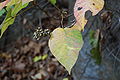 Poison ivy in Red River Gorge
 -
Foliage of poison ivy
-
 Video: How Poison Ivy Works
 -
Urushiol-induced contact dermatitis


