Tumor microenvironment: Difference between revisions
CSV import Tags: mobile edit mobile web edit |
CSV import |
||
| Line 1: | Line 1: | ||
== Tumor Microenvironment == | |||
The '''tumor microenvironment''' (TME) is the environment surrounding a [[tumor]], including the surrounding [[blood vessels]], [[immune cells]], [[fibroblasts]], [[signaling molecules]], and the [[extracellular matrix]] (ECM). The TME plays a crucial role in tumor development, progression, and response to therapy. | |||
The tumor microenvironment | == Components == | ||
The tumor microenvironment is composed of several key components: | |||
=== Cancer Cells === | |||
[[Cancer cells]] are the primary component of the tumor microenvironment. They interact with other components of the TME to promote tumor growth and metastasis. | |||
== | === Stromal Cells === | ||
[[Stromal cells]] include [[fibroblasts]], [[endothelial cells]], and [[pericytes]]. These cells contribute to the formation of the tumor stroma, which provides structural support and influences tumor behavior. | |||
=== | === Immune Cells === | ||
[[ | The TME contains various [[immune cells]], such as [[T cells]], [[B cells]], [[macrophages]], and [[natural killer cells]]. These cells can have both tumor-promoting and tumor-suppressing roles, depending on their state and the signals they receive from the tumor and its environment. | ||
=== | === Extracellular Matrix === | ||
[[ | The [[extracellular matrix]] (ECM) is a network of proteins and polysaccharides that provides structural support to the cells. It also plays a role in cell signaling and can influence cancer cell behavior. | ||
=== | === Signaling Molecules === | ||
The TME is rich in [[signaling molecules]] such as [[cytokines]], [[chemokines]], and [[growth factors]]. These molecules mediate communication between cancer cells and the surrounding stromal and immune cells. | |||
== | == Role in Cancer Progression == | ||
The | The tumor microenvironment is not just a passive bystander but actively participates in cancer progression. It can influence tumor growth, angiogenesis, immune evasion, and metastasis. The interactions between cancer cells and the TME can lead to the development of drug resistance, making the TME a target for therapeutic interventions. | ||
== | == Therapeutic Implications == | ||
Targeting the tumor microenvironment offers potential therapeutic strategies. Approaches include modifying the immune response, targeting stromal components, and altering the ECM to inhibit tumor progression and improve the efficacy of existing treatments. | |||
== | == Related Pages == | ||
* [[Cancer]] | * [[Cancer]] | ||
* [[ | * [[Metastasis]] | ||
* [[ | * [[Angiogenesis]] | ||
* [[ | * [[Immunotherapy]] | ||
== References == | |||
{{Reflist}} | |||
== Gallery == | |||
<gallery> | |||
File:Components-of-the-tumor-microenvironment.png|Components of the tumor microenvironment | |||
File:Tumour_stroma_and_extracellular_matrix_in_hypoxia.svg|Tumor stroma and extracellular matrix in hypoxia | |||
File:Stromal_cell_in_tumor_microenvironment.jpg|Stromal cell in tumor microenvironment | |||
File:HIF_regulates_interactions_of_cancer_cells_with_ECM_and_ECM_biosynthesis.svg|HIF regulates interactions of cancer cells with ECM | |||
File:Tumor_microenvironment.jpg|Tumor microenvironment | |||
File:Tumor-associated_immune_cells_in_the_tumor_microenvironment_(TME)_of_breast_cancer_models.svg|Tumor-associated immune cells in TME of breast cancer | |||
File:Immune_checkpoints_of_immunosuppressive_actions_associated_with_breast_cancer.svg|Immune checkpoints in breast cancer | |||
</gallery> | |||
[[Category:Cancer]] | [[Category:Cancer]] | ||
[[Category: | [[Category:Oncology]] | ||
Revision as of 00:39, 10 February 2025
Tumor Microenvironment
The tumor microenvironment (TME) is the environment surrounding a tumor, including the surrounding blood vessels, immune cells, fibroblasts, signaling molecules, and the extracellular matrix (ECM). The TME plays a crucial role in tumor development, progression, and response to therapy.
Components
The tumor microenvironment is composed of several key components:
Cancer Cells
Cancer cells are the primary component of the tumor microenvironment. They interact with other components of the TME to promote tumor growth and metastasis.
Stromal Cells
Stromal cells include fibroblasts, endothelial cells, and pericytes. These cells contribute to the formation of the tumor stroma, which provides structural support and influences tumor behavior.
Immune Cells
The TME contains various immune cells, such as T cells, B cells, macrophages, and natural killer cells. These cells can have both tumor-promoting and tumor-suppressing roles, depending on their state and the signals they receive from the tumor and its environment.
Extracellular Matrix
The extracellular matrix (ECM) is a network of proteins and polysaccharides that provides structural support to the cells. It also plays a role in cell signaling and can influence cancer cell behavior.
Signaling Molecules
The TME is rich in signaling molecules such as cytokines, chemokines, and growth factors. These molecules mediate communication between cancer cells and the surrounding stromal and immune cells.
Role in Cancer Progression
The tumor microenvironment is not just a passive bystander but actively participates in cancer progression. It can influence tumor growth, angiogenesis, immune evasion, and metastasis. The interactions between cancer cells and the TME can lead to the development of drug resistance, making the TME a target for therapeutic interventions.
Therapeutic Implications
Targeting the tumor microenvironment offers potential therapeutic strategies. Approaches include modifying the immune response, targeting stromal components, and altering the ECM to inhibit tumor progression and improve the efficacy of existing treatments.
Related Pages
References
<references group="" responsive="1"></references>
Gallery
-
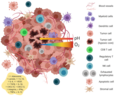 Components of the tumor microenvironment
 -
 Tumor stroma and extracellular matrix in hypoxia
 -
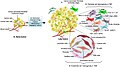 Stromal cell in tumor microenvironment
 -
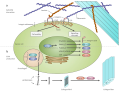 HIF regulates interactions of cancer cells with ECM
 -
 Tumor microenvironment
 -
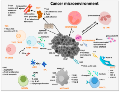 Tumor-associated immune cells in TME of breast cancer
 -
 Immune checkpoints in breast cancer


_of_breast_cancer_models.svg)

