Van der Waals equation: Difference between revisions
CSV import |
CSV import |
||
| Line 1: | Line 1: | ||
{{Short description|Equation of state for real gases}} | |||
The '''van der Waals equation''' is an equation of state that describes the behavior of real gases by accounting for the finite size of molecules and the attractive forces between them. It was first formulated by the Dutch physicist [[Johannes Diderik van der Waals]] in 1873, and it represents a significant improvement over the [[ideal gas law]] for gases at high pressures and low temperatures. | |||
The | |||
\ | ==Equation== | ||
The van der Waals equation is expressed as: | |||
:<math>\left( P + \frac{a}{V_m^2} \right) (V_m - b) = RT</math> | |||
where: | where: | ||
* | * ''P'' is the pressure of the gas, | ||
* | * ''V_m'' is the molar volume of the gas, | ||
* | * ''T'' is the absolute temperature, | ||
* | * ''R'' is the [[ideal gas constant]], | ||
* | * ''a'' is a measure of the attraction between particles, | ||
* ''b'' is the volume occupied by one mole of particles. | |||
The terms ''a'' and ''b'' are specific to each gas and are determined experimentally. | |||
The | |||
== | ==Derivation== | ||
The van der Waals equation modifies the ideal gas law by introducing two corrections: | |||
* The ''a'' term corrects for the intermolecular forces. In an ideal gas, it is assumed that there are no attractive forces between molecules. However, in real gases, these forces are significant, especially at high pressures and low temperatures. | |||
* The ''b'' term accounts for the finite size of molecules. In an ideal gas, it is assumed that the volume of the gas particles is negligible compared to the volume of the container. The ''b'' term corrects this by subtracting the volume occupied by the gas particles from the total volume. | |||
==Applications== | ==Applications== | ||
The | The van der Waals equation is used to predict the behavior of real gases under various conditions. It is particularly useful in the study of [[phase transitions]], such as the transition from gas to liquid. The equation can also be used to calculate critical properties, such as the [[critical temperature]], [[critical pressure]], and [[critical volume]] of a substance. | ||
==Limitations== | |||
While the van der Waals equation provides a better approximation than the ideal gas law, it is not perfect. It fails to accurately predict the behavior of gases at very high pressures and very low temperatures. More complex equations of state, such as the [[Redlich-Kwong equation]] and the [[Peng-Robinson equation]], have been developed to address these limitations. | |||
== | ==Related pages== | ||
* [[ | * [[Ideal gas law]] | ||
* [[Equation of state]] | * [[Equation of state]] | ||
* [[Critical point (thermodynamics)]] | * [[Critical point (thermodynamics)]] | ||
* [[Johannes Diderik van der Waals]] | * [[Johannes Diderik van der Waals]] | ||
[[Category: | ==References== | ||
* van der Waals, J. D. (1873). "On the Continuity of the Gaseous and Liquid States". PhD thesis, Leiden University. | |||
* Atkins, P., & de Paula, J. (2006). ''Physical Chemistry''. Oxford University Press. | |||
==Gallery== | |||
<gallery> | |||
File:VdWsurface2.jpg|Van der Waals surface | |||
File:VdW_surface_ideal3.png|Comparison with ideal gas | |||
File:VdW_surface3c.png|Van der Waals surface with critical point | |||
File:VdWaalsLeiden2020.jpg|Johannes Diderik van der Waals | |||
File:vdW_isotherms+2log.png|Isotherms of van der Waals gas | |||
File:Vdw5annotatedwith_dropping.png|Annotated van der Waals diagram | |||
File:Vdw_stability-saturation.png|Stability and saturation | |||
File:vapor_pressure_vs_temperature1.png|Vapor pressure vs temperature | |||
File:Tr_vs_Pitzer_factor.jpg|Tr vs Pitzer factor | |||
File:Vdw_inversion2.png|Inversion curve | |||
File:Vdw_Z_rho.png|Compressibility factor vs density | |||
File:Vdw_Z_p_r_1.png|Compressibility factor vs pressure | |||
</gallery> | |||
[[Category:Equations of state]] | |||
[[Category:Thermodynamics]] | [[Category:Thermodynamics]] | ||
Revision as of 00:33, 10 February 2025
Equation of state for real gases
The van der Waals equation is an equation of state that describes the behavior of real gases by accounting for the finite size of molecules and the attractive forces between them. It was first formulated by the Dutch physicist Johannes Diderik van der Waals in 1873, and it represents a significant improvement over the ideal gas law for gases at high pressures and low temperatures.
Equation
The van der Waals equation is expressed as:
where:
- P is the pressure of the gas,
- V_m is the molar volume of the gas,
- T is the absolute temperature,
- R is the ideal gas constant,
- a is a measure of the attraction between particles,
- b is the volume occupied by one mole of particles.
The terms a and b are specific to each gas and are determined experimentally.
Derivation
The van der Waals equation modifies the ideal gas law by introducing two corrections:
- The a term corrects for the intermolecular forces. In an ideal gas, it is assumed that there are no attractive forces between molecules. However, in real gases, these forces are significant, especially at high pressures and low temperatures.
- The b term accounts for the finite size of molecules. In an ideal gas, it is assumed that the volume of the gas particles is negligible compared to the volume of the container. The b term corrects this by subtracting the volume occupied by the gas particles from the total volume.
Applications
The van der Waals equation is used to predict the behavior of real gases under various conditions. It is particularly useful in the study of phase transitions, such as the transition from gas to liquid. The equation can also be used to calculate critical properties, such as the critical temperature, critical pressure, and critical volume of a substance.
Limitations
While the van der Waals equation provides a better approximation than the ideal gas law, it is not perfect. It fails to accurately predict the behavior of gases at very high pressures and very low temperatures. More complex equations of state, such as the Redlich-Kwong equation and the Peng-Robinson equation, have been developed to address these limitations.
Related pages
References
- van der Waals, J. D. (1873). "On the Continuity of the Gaseous and Liquid States". PhD thesis, Leiden University.
- Atkins, P., & de Paula, J. (2006). Physical Chemistry. Oxford University Press.
Gallery
-
 Van der Waals surface
 -
 Comparison with ideal gas
 -
 Van der Waals surface with critical point
 -
 Johannes Diderik van der Waals
 -
 Isotherms of van der Waals gas
 -
 Annotated van der Waals diagram
 -
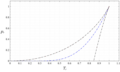 Stability and saturation
 -
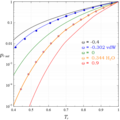 Vapor pressure vs temperature
 -
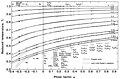 Tr vs Pitzer factor
 -
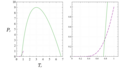 Inversion curve
 -
 Compressibility factor vs density
 -
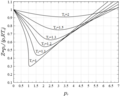 Compressibility factor vs pressure


