Trade union: Difference between revisions
CSV import |
CSV import |
||
| Line 1: | Line 1: | ||
''' | == Trade Union == | ||
[[File:Garment_Workers_on_Strike,_New_York_City_circa_1913.jpg|Garment Workers on Strike, New York City, circa 1913|thumb]] | |||
[[File:London_Trades_Demonstration.jpg|London Trades Demonstration|left|thumb]] | |||
[[File:1912_Lawrence_Textile_Strike_1.jpg|1912 Lawrence Textile Strike|thumb]] | |||
[[File:Trade_union_density_rate_map.svg|Trade Union Density Rate Map|thumb]] | |||
A '''trade union''', also known as a '''labor union''', is an organization of workers who have come together to achieve common goals such as protecting the integrity of their trade, improving safety standards, achieving higher pay and benefits such as health care and retirement, increasing the number of employees an employer hires, and better working conditions. The trade union, through its leadership, bargains with the employer on behalf of union members (rank and file members) and negotiates labor contracts (collective bargaining) with employers. | |||
== History == | == History == | ||
The origins of unions | The origins of trade unions can be traced back to the 18th century in Britain, where the rapid expansion of industrial society drew women, children, rural workers, and immigrants to the workforce in large numbers and in new roles. This led to the formation of trade unions to protect the interests of workers. | ||
In the United States, the first effective labor organization was the [[Knights of Labor]], founded in 1869. The [[American Federation of Labor]] (AFL) was established in 1886, focusing on skilled workers. The [[Industrial Workers of the World]] (IWW), founded in 1905, aimed to unite all workers into one large union. | |||
== Functions == | |||
Trade unions perform several functions: | |||
* '''Collective Bargaining''': Negotiating with employers on behalf of union members. | |||
* '''Political Activity''': Lobbying for legislation favorable to workers. | |||
* '''Member Services''': Providing legal advice and representation, training, and other services. | |||
== Impact == | |||
Trade unions have played a significant role in improving the working conditions and wages of workers. They have been instrumental in the establishment of labor laws and standards, such as the eight-hour workday, minimum wage laws, and workplace safety regulations. | |||
== Challenges == | |||
Trade unions face several challenges in the modern era, including declining membership, globalization, and changes in the nature of work. The rise of the gig economy and the decline of manufacturing jobs have also impacted union membership. | |||
== | == Related Pages == | ||
* [[Collective bargaining]] | |||
* [[Labor rights]] | * [[Labor rights]] | ||
* [[ | * [[Industrial Workers of the World]] | ||
* [[ | * [[American Federation of Labor]] | ||
* [[ | * [[Knights of Labor]] | ||
== Gallery == | |||
<gallery> | |||
File:Labor_union_membership_by_country.webp|Labor Union Membership by Country | |||
File:Hours_Worked_Compared_to_Earnings_Per_Week.webp|Hours Worked Compared to Earnings Per Week | |||
File:Cesar_chavez2.jpg|Cesar Chavez | |||
File:Great_Railway_Strike_1886_-_E_St_Louis.jpg|Great Railway Strike of 1886 | |||
File:Unison_strike_rally_Oxford_20060328.jpg|Unison Strike Rally, Oxford | |||
File:1907-_Income_inequality_and_union_participation.svg|Income Inequality and Union Participation | |||
</gallery> | |||
[[Category:Trade unions]] | [[Category:Trade unions]] | ||
Latest revision as of 00:33, 10 February 2025
Trade Union[edit]


A trade union, also known as a labor union, is an organization of workers who have come together to achieve common goals such as protecting the integrity of their trade, improving safety standards, achieving higher pay and benefits such as health care and retirement, increasing the number of employees an employer hires, and better working conditions. The trade union, through its leadership, bargains with the employer on behalf of union members (rank and file members) and negotiates labor contracts (collective bargaining) with employers.
History[edit]
The origins of trade unions can be traced back to the 18th century in Britain, where the rapid expansion of industrial society drew women, children, rural workers, and immigrants to the workforce in large numbers and in new roles. This led to the formation of trade unions to protect the interests of workers.
In the United States, the first effective labor organization was the Knights of Labor, founded in 1869. The American Federation of Labor (AFL) was established in 1886, focusing on skilled workers. The Industrial Workers of the World (IWW), founded in 1905, aimed to unite all workers into one large union.
Functions[edit]
Trade unions perform several functions:
- Collective Bargaining: Negotiating with employers on behalf of union members.
- Political Activity: Lobbying for legislation favorable to workers.
- Member Services: Providing legal advice and representation, training, and other services.
Impact[edit]
Trade unions have played a significant role in improving the working conditions and wages of workers. They have been instrumental in the establishment of labor laws and standards, such as the eight-hour workday, minimum wage laws, and workplace safety regulations.
Challenges[edit]
Trade unions face several challenges in the modern era, including declining membership, globalization, and changes in the nature of work. The rise of the gig economy and the decline of manufacturing jobs have also impacted union membership.
Related Pages[edit]
- Collective bargaining
- Labor rights
- Industrial Workers of the World
- American Federation of Labor
- Knights of Labor
Gallery[edit]
-
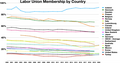 Labor Union Membership by Country
 -
 Hours Worked Compared to Earnings Per Week
 -
 Cesar Chavez
 -
 Great Railway Strike of 1886
 -
 Unison Strike Rally, Oxford
 -
 Income Inequality and Union Participation


