Teeth blackening: Difference between revisions
CSV import |
CSV import |
||
| Line 1: | Line 1: | ||
{{Short description|Traditional practice of blackening teeth for cultural or aesthetic reasons}} | |||
{{Infobox cultural practice | |||
| name = Teeth blackening | |||
| image = Woman from Akha tribe.jpg | |||
| caption = A woman from the Akha tribe with blackened teeth | |||
| type = Cultural practice | |||
| origin = Various cultures | |||
}} | |||
'''Teeth blackening''', also known as '''teeth lacquering''', is a traditional practice of dyeing the teeth black. This custom has been observed in various cultures around the world, particularly in Southeast Asia, Japan, and some Pacific Islands. The practice is often associated with cultural identity, beauty, and social status. | |||
Teeth blackening has been practiced | ==History and Cultural Significance== | ||
Teeth blackening has a long history and has been practiced for centuries. In Japan, the practice is known as ''ohaguro'' (お歯黒), and it was common among married women and aristocrats during the Heian period (794-1185). The blackening of teeth was considered a sign of maturity and beauty. It was also believed to protect the teeth from decay. | |||
In Southeast Asia, particularly in Vietnam and Thailand, teeth blackening was a common practice among various ethnic groups. It was often performed during puberty or as part of marriage rituals. The blackened teeth were seen as a mark of beauty and a deterrent against evil spirits. | |||
In the Pacific Islands, such as the Solomon Islands, teeth blackening was part of traditional rites and was associated with social status and identity. | |||
== | ==Methods of Teeth Blackening== | ||
The process of teeth blackening typically involves applying a mixture of natural ingredients to the teeth. Common ingredients include: | |||
* Iron filings or iron salts | |||
* Tannins from plant sources such as tea or gallnuts | |||
* Acids from vinegar or other sour substances | |||
The mixture is applied to the teeth and left to stain them black. The process may need to be repeated several times to achieve the desired effect. | |||
==Decline and Modern Perception== | |||
With the advent of modern dentistry and changing beauty standards, the practice of teeth blackening has declined significantly. In many cultures, it is now seen as an outdated tradition. However, it still holds cultural significance in some communities and is sometimes practiced during traditional ceremonies or festivals. | |||
== | ==Also see== | ||
* [[Ohaguro]] | |||
* [[Cultural practices of Southeast Asia]] | |||
* [[Body modification]] | |||
* [[Traditional Japanese culture]] | |||
==Gallery== | |||
<gallery> | |||
File:Yoshitoshi-24-Hours-1880.jpg|A depiction of a woman with blackened teeth in a Japanese woodblock print | |||
File:Yamanba and kintaro sakazuki.jpg|Traditional Japanese art showing a woman with blackened teeth | |||
File:Xã Bát Tràng、鉢塲社 バチャン村 DSCF2605.JPG|Cultural artifacts from regions where teeth blackening was practiced | |||
</gallery> | |||
{{Cultural practices}} | |||
{{Body modification}} | |||
[[Category: | |||
[[Category:Cultural practices]] | |||
[[Category:Body modification]] | [[Category:Body modification]] | ||
[[Category: | [[Category:Oral traditions]] | ||
Latest revision as of 02:59, 11 December 2024
Traditional practice of blackening teeth for cultural or aesthetic reasons
Template:Infobox cultural practice
Teeth blackening, also known as teeth lacquering, is a traditional practice of dyeing the teeth black. This custom has been observed in various cultures around the world, particularly in Southeast Asia, Japan, and some Pacific Islands. The practice is often associated with cultural identity, beauty, and social status.
History and Cultural Significance[edit]
Teeth blackening has a long history and has been practiced for centuries. In Japan, the practice is known as ohaguro (お歯黒), and it was common among married women and aristocrats during the Heian period (794-1185). The blackening of teeth was considered a sign of maturity and beauty. It was also believed to protect the teeth from decay.
In Southeast Asia, particularly in Vietnam and Thailand, teeth blackening was a common practice among various ethnic groups. It was often performed during puberty or as part of marriage rituals. The blackened teeth were seen as a mark of beauty and a deterrent against evil spirits.
In the Pacific Islands, such as the Solomon Islands, teeth blackening was part of traditional rites and was associated with social status and identity.
Methods of Teeth Blackening[edit]
The process of teeth blackening typically involves applying a mixture of natural ingredients to the teeth. Common ingredients include:
- Iron filings or iron salts
- Tannins from plant sources such as tea or gallnuts
- Acids from vinegar or other sour substances
The mixture is applied to the teeth and left to stain them black. The process may need to be repeated several times to achieve the desired effect.
Decline and Modern Perception[edit]
With the advent of modern dentistry and changing beauty standards, the practice of teeth blackening has declined significantly. In many cultures, it is now seen as an outdated tradition. However, it still holds cultural significance in some communities and is sometimes practiced during traditional ceremonies or festivals.
Also see[edit]
Gallery[edit]
-
 A depiction of a woman with blackened teeth in a Japanese woodblock print
 -
 Traditional Japanese art showing a woman with blackened teeth
 -
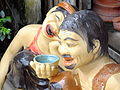 Cultural artifacts from regions where teeth blackening was practiced


