Abdullah Öcalan: Difference between revisions
CSV import |
CSV import |
||
| Line 1: | Line 1: | ||
{{Infobox person | |||
| name = Abdullah Öcalan | |||
| image = [[File:Abdullah Öcalan.png|thumb]] | |||
| caption = Abdullah Öcalan | |||
| birth_date = 4 April 1949 | |||
| birth_place = Ömerli, Şanlıurfa Province, Turkey | |||
| nationality = Kurdish | |||
| known_for = Founding the [[Kurdistan Workers' Party]] (PKK) | |||
| occupation = Political leader | |||
}} | |||
Abdullah Öcalan | '''Abdullah Öcalan''' (born 4 April 1949) is a Kurdish political leader and one of the founding members of the [[Kurdistan Workers' Party]] (PKK), a militant organization that has been involved in an armed struggle against the Turkish state for greater autonomy and rights for Kurds in Turkey. Öcalan has been imprisoned in Turkey since 1999. | ||
== Early Life and Education == | |||
Öcalan was born in the village of Ömerli | Öcalan was born in the village of Ömerli in the Şanlıurfa Province of Turkey. He grew up in a rural Kurdish family and later moved to Istanbul for his education. He attended the University of Ankara, where he became involved in leftist politics and Kurdish activism. | ||
== Founding of the PKK == | |||
In 1978, | In 1978, Öcalan co-founded the [[Kurdistan Workers' Party]] (PKK) with the aim of establishing an independent Kurdish state. The PKK initially engaged in political activities but later took up arms against the Turkish government in 1984, marking the beginning of a long and violent conflict. | ||
== Capture and Imprisonment == | |||
In 1999, Öcalan was captured in Nairobi, Kenya, in an operation involving multiple intelligence agencies | In 1999, Öcalan was captured in Nairobi, Kenya, in an operation involving multiple intelligence agencies. He was brought to Turkey, where he was tried and sentenced to death. His sentence was later commuted to life imprisonment following the abolition of the death penalty in Turkey. Öcalan has been held in solitary confinement on İmralı Island since his capture. | ||
Öcalan has | == Ideology and Influence == | ||
Öcalan's ideology has evolved over time. Initially advocating for an independent Kurdish state, he later shifted towards promoting democratic confederalism, a form of governance that emphasizes local autonomy and direct democracy. His writings and ideas have influenced Kurdish movements not only in Turkey but also in Syria and Iraq. | |||
== | == Peace Process and Current Status == | ||
Öcalan has played a significant role in peace negotiations between the PKK and the Turkish government. Despite being imprisoned, he has communicated with PKK leaders and Turkish officials to broker ceasefires and propose political solutions. However, the peace process has faced numerous challenges and setbacks. | |||
== Also see == | |||
* [[Kurdistan Workers' Party]] | |||
* [[Kurdish–Turkish conflict]] | |||
* [[Democratic confederalism]] | |||
* [[Kurdish nationalism]] | |||
== | == Gallery == | ||
Abdullah | <gallery> | ||
File:Abdullah Ocalan ( Greyer and tempered by long isolation, PKK leader is braving the scepticism of many Turks, and some of his own fighters).jpg|Öcalan in isolation | |||
File:Pkk supporters london april 2003.jpg|PKK supporters in London, April 2003 | |||
File:PKK Verbot.jpg|Protest against the PKK ban | |||
</gallery> | |||
{{Authority control}} | |||
[[Category:Kurdish politicians]] | [[Category:Kurdish politicians]] | ||
[[Category:Kurdish nationalists]] | |||
[[Category:1949 births]] | [[Category:1949 births]] | ||
[[Category:Living people]] | [[Category:Living people]] | ||
Revision as of 02:54, 11 December 2024
Abdullah Öcalan (born 4 April 1949) is a Kurdish political leader and one of the founding members of the Kurdistan Workers' Party (PKK), a militant organization that has been involved in an armed struggle against the Turkish state for greater autonomy and rights for Kurds in Turkey. Öcalan has been imprisoned in Turkey since 1999.
Early Life and Education
Öcalan was born in the village of Ömerli in the Şanlıurfa Province of Turkey. He grew up in a rural Kurdish family and later moved to Istanbul for his education. He attended the University of Ankara, where he became involved in leftist politics and Kurdish activism.
Founding of the PKK
In 1978, Öcalan co-founded the Kurdistan Workers' Party (PKK) with the aim of establishing an independent Kurdish state. The PKK initially engaged in political activities but later took up arms against the Turkish government in 1984, marking the beginning of a long and violent conflict.
Capture and Imprisonment
In 1999, Öcalan was captured in Nairobi, Kenya, in an operation involving multiple intelligence agencies. He was brought to Turkey, where he was tried and sentenced to death. His sentence was later commuted to life imprisonment following the abolition of the death penalty in Turkey. Öcalan has been held in solitary confinement on İmralı Island since his capture.
Ideology and Influence
Öcalan's ideology has evolved over time. Initially advocating for an independent Kurdish state, he later shifted towards promoting democratic confederalism, a form of governance that emphasizes local autonomy and direct democracy. His writings and ideas have influenced Kurdish movements not only in Turkey but also in Syria and Iraq.
Peace Process and Current Status
Öcalan has played a significant role in peace negotiations between the PKK and the Turkish government. Despite being imprisoned, he has communicated with PKK leaders and Turkish officials to broker ceasefires and propose political solutions. However, the peace process has faced numerous challenges and setbacks.
Also see
Gallery
-
Öcalan in isolation
-
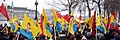 PKK supporters in London, April 2003
 -
 Protest against the PKK ban


.jpg)