Saccharomyces cerevisiae: Difference between revisions
mNo edit summary |
CSV import |
||
| Line 1: | Line 1: | ||
{{Short description|Species of yeast}} | |||
{{Taxobox | |||
| name = Saccharomyces cerevisiae | |||
| image = Saccharomyces cerevisiae SEM.jpg | |||
| image_caption = ''Saccharomyces cerevisiae'' under scanning electron microscopy | |||
| domain = Eukaryota | |||
| regnum = Fungi | |||
| phylum = Ascomycota | |||
| classis = Saccharomycetes | |||
| ordo = Saccharomycetales | |||
| familia = Saccharomycetaceae | |||
| genus = Saccharomyces | |||
| species = ''S. cerevisiae'' | |||
| binomial = ''Saccharomyces cerevisiae'' | |||
| binomial_authority = Meyen ex E.C. Hansen | |||
}} | |||
'''''Saccharomyces cerevisiae''''' is a species of yeast. It has been instrumental in winemaking, baking, and brewing since ancient times. It is believed to have been originally isolated from the skin of grapes. ''S. cerevisiae'' cells are round to ovoid, 5–10 micrometers in diameter. It reproduces by a division process known as budding. | |||
==Biology== | |||
''Saccharomyces cerevisiae'' is a unicellular fungus that is classified as a member of the kingdom Fungi, the phylum Ascomycota, and the class Saccharomycetes. It is a model organism in cell biology research, particularly in the study of the cell cycle, cell division, and genetics. | |||
== | ===Reproduction=== | ||
''S. cerevisiae'' reproduces asexually by budding. During this process, a small bud forms on the parent cell, grows, and eventually detaches to become a new cell. It can also reproduce sexually through a process involving the fusion of two haploid cells to form a diploid cell, which can undergo meiosis to produce spores. | |||
===Metabolism=== | |||
''S. cerevisiae'' is a facultative anaerobe, meaning it can survive in both aerobic and anaerobic environments. In the presence of oxygen, it performs aerobic respiration, while in the absence of oxygen, it switches to fermentation, producing ethanol and carbon dioxide. | |||
== | ==Applications== | ||
''Saccharomyces cerevisiae'' is widely used in the food and beverage industry. It is the yeast responsible for the fermentation of sugars in the production of beer, wine, and bread. In baking, the carbon dioxide produced by the yeast causes dough to rise. | |||
===Biotechnology=== | |||
In biotechnology, ''S. cerevisiae'' is used as a model organism for research and as a host for the production of recombinant proteins. Its well-characterized genetics and ease of manipulation make it an ideal organism for genetic engineering. | |||
==Research== | |||
''S. cerevisiae'' has been extensively studied in the field of genetics and molecular biology. It was the first eukaryotic organism to have its genome completely sequenced. This yeast serves as a model for understanding the basic mechanisms of eukaryotic cells, including DNA replication, recombination, cell division, and metabolism. | |||
== | ==Gallery== | ||
<gallery> | |||
File:Laboratoorne pagaripärm (Saccharomyces cerevisiae) agariplaadil..JPG|''S. cerevisiae'' on an agar plate | |||
File:Shmoos s cerevisiae.jpg|''S. cerevisiae'' cells showing shmoo formation | |||
File:S cerevisiae under DIC microscopy.jpg|''S. cerevisiae'' under differential interference contrast microscopy | |||
</gallery> | |||
== | ==Also see== | ||
* [[Yeast]] | |||
* [[Fermentation]] | |||
* [[Baker's yeast]] | |||
* [[Brewer's yeast]] | |||
* [[Model organism]] | |||
{{Fungi}} | |||
{{Yeasts}} | |||
[[Category:Saccharomyces cerevisiae| ]] | |||
[[Category:Yeasts]] | |||
[[Category:Model organisms]] | |||
[ | |||
[[Category: | |||
[[Category: | |||
[[Category:Biotechnology]] | [[Category:Biotechnology]] | ||
Latest revision as of 02:52, 11 December 2024
Species of yeast
Saccharomyces cerevisiae is a species of yeast. It has been instrumental in winemaking, baking, and brewing since ancient times. It is believed to have been originally isolated from the skin of grapes. S. cerevisiae cells are round to ovoid, 5–10 micrometers in diameter. It reproduces by a division process known as budding.
Biology[edit]
Saccharomyces cerevisiae is a unicellular fungus that is classified as a member of the kingdom Fungi, the phylum Ascomycota, and the class Saccharomycetes. It is a model organism in cell biology research, particularly in the study of the cell cycle, cell division, and genetics.
Reproduction[edit]
S. cerevisiae reproduces asexually by budding. During this process, a small bud forms on the parent cell, grows, and eventually detaches to become a new cell. It can also reproduce sexually through a process involving the fusion of two haploid cells to form a diploid cell, which can undergo meiosis to produce spores.
Metabolism[edit]
S. cerevisiae is a facultative anaerobe, meaning it can survive in both aerobic and anaerobic environments. In the presence of oxygen, it performs aerobic respiration, while in the absence of oxygen, it switches to fermentation, producing ethanol and carbon dioxide.
Applications[edit]
Saccharomyces cerevisiae is widely used in the food and beverage industry. It is the yeast responsible for the fermentation of sugars in the production of beer, wine, and bread. In baking, the carbon dioxide produced by the yeast causes dough to rise.
Biotechnology[edit]
In biotechnology, S. cerevisiae is used as a model organism for research and as a host for the production of recombinant proteins. Its well-characterized genetics and ease of manipulation make it an ideal organism for genetic engineering.
Research[edit]
S. cerevisiae has been extensively studied in the field of genetics and molecular biology. It was the first eukaryotic organism to have its genome completely sequenced. This yeast serves as a model for understanding the basic mechanisms of eukaryotic cells, including DNA replication, recombination, cell division, and metabolism.
Gallery[edit]
-
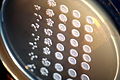 S. cerevisiae on an agar plate
 -
 S. cerevisiae cells showing shmoo formation
 -
 S. cerevisiae under differential interference contrast microscopy
_agariplaadil..JPG)


