Hemoglobin: Difference between revisions
CSV import |
|||
| Line 20: | Line 20: | ||
* [[Thalassemia]]: A genetic blood disorder that causes the body to make fewer healthy red blood cells and less hemoglobin than normal. | * [[Thalassemia]]: A genetic blood disorder that causes the body to make fewer healthy red blood cells and less hemoglobin than normal. | ||
== | == Gallery == | ||
<gallery> | <gallery> | ||
File:1GZX_Haemoglobin.png|1GZX Haemoglobin | File:1GZX_Haemoglobin.png|1GZX Haemoglobin | ||
| Line 39: | Line 29: | ||
File:Hemoglobin_saturation_curve.svg|Hemoglobin Saturation Curve | File:Hemoglobin_saturation_curve.svg|Hemoglobin Saturation Curve | ||
File:Postnatal_genetics_en.svg|Postnatal Genetics | File:Postnatal_genetics_en.svg|Postnatal Genetics | ||
File:Hemoglobin_Test_American_Red_Cross.jpg|Hemoglobin Test American Red Cross | File:Hemoglobin_Test_American_Red_Cross.jpg|Hemoglobin Test American Red Cross | ||
File:Riftia_tube_worms_Galapagos_2011.jpg|Riftia Tube Worms Galapagos 2011 | File:Riftia_tube_worms_Galapagos_2011.jpg|Riftia Tube Worms Galapagos 2011 | ||
File:Heart_of_Steel_(Hemoglobin).jpg|Heart of Steel (Hemoglobin) | File:Heart_of_Steel_(Hemoglobin).jpg|Heart of Steel (Hemoglobin) | ||
</gallery> | </gallery> | ||
== See also == | |||
* [[Red blood cell]] | |||
* [[Oxygen transport]] | |||
* [[Carbon dioxide transport]] | |||
[[Category:Proteins]] | |||
[[Category:Blood]] | |||
[[Category:Respiratory system]] | |||
{{stub}} | |||
{{dictionary-stub1}} | |||
Latest revision as of 23:56, 23 February 2025
Hemoglobin is a protein in red blood cells that carries oxygen from the lungs to the body's tissues and returns carbon dioxide from the tissues back to the lungs. Hemoglobin is made up of four protein molecules (globulin chains) that are connected together.
Structure[edit]
The hemoglobin molecule is a complex structure made up of four globulin chains, each of which is attached to a heme group. The heme group contains an iron atom, which is capable of binding to a molecule of oxygen. Each hemoglobin molecule can therefore carry four molecules of oxygen.
Function[edit]
The primary function of hemoglobin is to transport oxygen from the lungs to the tissues of the body, where it is used for cellular respiration. Hemoglobin also helps in the transport of carbon dioxide and hydrogen ions back to the lungs.
Hemoglobin levels[edit]
Normal hemoglobin levels can vary depending on the individual and the laboratory that analyzes the blood sample. However, typical values are:
- Men: 13.5 to 17.5 grams per deciliter (g/dL)
- Women: 12.0 to 15.5 g/dL
[edit]
There are several disorders related to hemoglobin, including:
- Anemia: A condition in which the body does not have enough healthy red blood cells to provide adequate oxygen to body tissues.
- Sickle cell disease: A genetic disorder that affects hemoglobin and can lead to various complications, including pain episodes, swelling of hands and feet, frequent infections, and vision problems.
- Thalassemia: A genetic blood disorder that causes the body to make fewer healthy red blood cells and less hemoglobin than normal.
Gallery[edit]
-
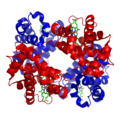 1GZX Haemoglobin
 -
 Max Perutz
 -
 Hemoglobin ABD Alignment
 -
 Heme B
 -
 Hemoglobin T-R State Animation
 -
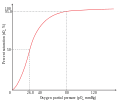 Hemoglobin Saturation Curve
 -
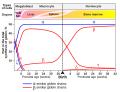 Postnatal Genetics
 -
 Hemoglobin Test American Red Cross
 -
 Riftia Tube Worms Galapagos 2011
 -
 Heart of Steel (Hemoglobin)


.jpg)


