Thymectomy: Difference between revisions
CSV import Tags: mobile edit mobile web edit |
CSV import |
||
| Line 40: | Line 40: | ||
[[Category:Immune system]] | [[Category:Immune system]] | ||
[[Category:Thoracic surgery]] | [[Category:Thoracic surgery]] | ||
<gallery> | |||
File:AfterThymectomy.JPG|Thymectomy | |||
</gallery> | |||
Latest revision as of 00:40, 20 February 2025
Surgical procedure to remove the thymus gland
Thymectomy[edit]
A thymectomy is a surgical procedure performed to remove the thymus gland. The thymus is a specialized primary lymphoid organ of the immune system. Located in the upper anterior part of the chest cavity, it plays a crucial role in the development of T-cells, which are essential for the adaptive immune system.
Indications[edit]
Thymectomy is primarily indicated for the treatment of myasthenia gravis, a chronic autoimmune neuromuscular disease characterized by varying degrees of weakness of the skeletal muscles of the body. It is also performed in cases of thymoma, a tumor originating from the epithelial cells of the thymus, and other thymic abnormalities.
Myasthenia Gravis[edit]
In patients with myasthenia gravis, thymectomy is considered when medical management is insufficient. The procedure can lead to improvement in symptoms and may reduce the need for immunosuppressive medications.
Thymoma[edit]
Thymectomy is the treatment of choice for thymomas, which can be benign or malignant. Complete surgical resection is often curative for early-stage thymomas.
Surgical Techniques[edit]
Several surgical approaches can be used to perform a thymectomy, each with its own advantages and disadvantages.
Transsternal Thymectomy[edit]
This traditional approach involves a median sternotomy, where the sternum is divided to provide access to the thymus. It allows for complete removal of the thymus and is often used for large thymomas.
Video-Assisted Thoracoscopic Surgery (VATS)[edit]
VATS thymectomy is a minimally invasive technique that uses small incisions and a camera to guide the surgery. It is associated with less postoperative pain and a shorter recovery time compared to the transsternal approach.
Robotic-Assisted Thymectomy[edit]
Robotic-assisted thymectomy is another minimally invasive option that provides enhanced precision and visualization. It is particularly useful for complex cases and offers similar benefits to VATS.
Postoperative Care[edit]
After a thymectomy, patients are monitored for complications such as infection, bleeding, and respiratory issues. Pain management and respiratory exercises are important components of postoperative care to ensure a smooth recovery.
Prognosis[edit]
The prognosis after thymectomy varies depending on the underlying condition. In myasthenia gravis, many patients experience significant improvement in symptoms. For thymoma, the prognosis depends on the stage and completeness of tumor resection.
Related pages[edit]
-
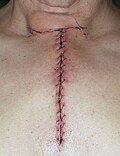 Thymectomy

