Apex predator: Difference between revisions
CSV import |
CSV import |
||
| Line 44: | Line 44: | ||
[[Category:Ecology]] | [[Category:Ecology]] | ||
[[Category:Predators]] | [[Category:Predators]] | ||
<gallery> | |||
File:020_The_lion_king_Snyggve_in_the_Serengeti_National_Park_Photo_by_Giles_Laurent.jpg|The lion king Snyggve in the Serengeti National Park | |||
File:SaltwaterCrocodile('Maximo').jpg|Saltwater Crocodile ('Maximo') | |||
File:Comparison_of_size_of_orca_and_great_white_shark.svg|Comparison of size of orca and great white shark | |||
File:Skua_Runde.jpg|Skua Runde | |||
File:Canis_lupus_pack_surrounding_Bison.jpg|Canis lupus pack surrounding Bison | |||
File:21_Walrus_Hunt_1999.jpg|Walrus Hunt 1999 | |||
File:20191203_Anomalocaris_canadensis.png|Anomalocaris canadensis | |||
File:37-svaghi,_caccia,Taccuino_Sanitatis,_Casanatense_4182..jpg|Svaghi, caccia, Taccuino Sanitatis, Casanatense 4182 | |||
File:Tiger_shark_size.svg|Tiger shark size | |||
File:Lynx_Lynx_(10597310204).jpg|Lynx Lynx | |||
</gallery> | |||
Latest revision as of 21:02, 25 February 2025
A detailed overview of apex predators in the ecosystem
Apex Predator[edit]
An apex predator, also known as an alpha predator or top predator, is a predator residing at the top of a food chain upon which no other creatures prey. Apex predators are crucial in maintaining the health and balance of their ecosystems.
Characteristics[edit]
Apex predators are characterized by their position at the top of the food chain. They have few or no natural predators and play a critical role in controlling the populations of other species. This control helps to maintain the structure and stability of the ecosystem.
Diet[edit]
Apex predators typically have a varied diet that includes a wide range of prey species. Their diet can include herbivores, smaller predators, and sometimes even other apex predators. For example, the great white shark is known to prey on seals, dolphins, and even smaller sharks.
Adaptations[edit]
Apex predators have evolved various adaptations that make them effective hunters. These adaptations can include sharp teeth and claws, keen senses, and powerful bodies. For instance, the bald eagle has excellent eyesight that allows it to spot prey from great distances.
Ecological Role[edit]
Apex predators play a vital role in maintaining the health of their ecosystems. By controlling the populations of prey species, they help to prevent overgrazing and the depletion of vegetation. This, in turn, supports a diverse range of species and promotes biodiversity.
Trophic Cascades[edit]
The presence or absence of apex predators can lead to trophic cascades, which are powerful indirect interactions that can control entire ecosystems. For example, the reintroduction of wolves to Yellowstone National Park led to a decrease in the elk population, which allowed for the regeneration of vegetation and increased biodiversity.
Examples of Apex Predators[edit]
Terrestrial Apex Predators[edit]
- Lion (Panthera leo): Known as the "king of the jungle," lions are apex predators in the African savanna. They primarily hunt large herbivores such as zebras and wildebeests.
- Tiger (Panthera tigris): Tigers are solitary hunters found in Asia. They prey on a variety of animals, including deer and wild boar.
Marine Apex Predators[edit]
- Orca (Orcinus orca): Also known as killer whales, orcas are apex predators in the ocean. They have a diverse diet that includes fish, seals, and even whales.
- Great White Shark (Carcharodon carcharias): These sharks are top predators in marine environments, known for their powerful jaws and sharp teeth.
Avian Apex Predators[edit]
- Bald Eagle (Haliaeetus leucocephalus): As a top predator in North America, the bald eagle preys on fish and small mammals.
- Harpy Eagle (Harpia harpyja): Found in the rainforests of Central and South America, the harpy eagle preys on monkeys and sloths.
Conservation[edit]
Many apex predators are threatened by human activities such as habitat destruction, pollution, and hunting. Conservation efforts are crucial to protect these species and maintain the balance of ecosystems. Protected areas, wildlife corridors, and legal protections are some of the measures used to conserve apex predators.
Related Pages[edit]
-
 The lion king Snyggve in the Serengeti National Park
 -
 Saltwater Crocodile ('Maximo')
 -
 Comparison of size of orca and great white shark
 -
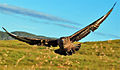 Skua Runde
 -
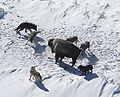 Canis lupus pack surrounding Bison
 -
 Walrus Hunt 1999
 -
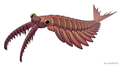 Anomalocaris canadensis
 -
Svaghi, caccia, Taccuino Sanitatis, Casanatense 4182
-
Tiger shark size
-
Lynx Lynx

.jpg)


.jpg)