Boronic acid: Difference between revisions
CSV import Tags: mobile edit mobile web edit |
No edit summary |
||
| Line 1: | Line 1: | ||
{{Short description|Chemical compounds containing a boron atom bonded to an oxygen atom and a hydroxyl group}} | {{Short description|Chemical compounds containing a boron atom bonded to an oxygen atom and a hydroxyl group}} | ||
'''Boronic acids''' are a class of organic compounds that contain a boron atom bonded to an oxygen atom and a hydroxyl group. They have the general formula R-B(OH)_, where R is an organic substituent. Boronic acids are important in organic chemistry and have applications in medicinal chemistry, materials science, and as reagents in organic synthesis. | '''Boronic acids''' are a class of organic compounds that contain a boron atom bonded to an oxygen atom and a hydroxyl group. They have the general formula R-B(OH)_, where R is an organic substituent. Boronic acids are important in organic chemistry and have applications in medicinal chemistry, materials science, and as reagents in organic synthesis. | ||
| Line 16: | Line 12: | ||
=== Organic Synthesis === | === Organic Synthesis === | ||
Boronic acids are widely used in organic synthesis, particularly in the [[Suzuki coupling]] reaction. This reaction involves the coupling of a boronic acid with an aryl or vinyl halide in the presence of a palladium catalyst and a base, forming a carbon-carbon bond. The Suzuki reaction is a powerful tool for constructing complex organic molecules and is used extensively in the synthesis of pharmaceuticals and natural products. | Boronic acids are widely used in organic synthesis, particularly in the [[Suzuki coupling]] reaction. This reaction involves the coupling of a boronic acid with an aryl or vinyl halide in the presence of a palladium catalyst and a base, forming a carbon-carbon bond. The Suzuki reaction is a powerful tool for constructing complex organic molecules and is used extensively in the synthesis of pharmaceuticals and natural products. | ||
| Line 33: | Line 27: | ||
Boronic acids can be synthesized through several methods, including the hydrolysis of boronic esters, the reaction of organolithium or Grignard reagents with borate esters, and the direct borylation of aromatic compounds using transition metal catalysts. | Boronic acids can be synthesized through several methods, including the hydrolysis of boronic esters, the reaction of organolithium or Grignard reagents with borate esters, and the direct borylation of aromatic compounds using transition metal catalysts. | ||
== Gallery == | |||
<gallery> | |||
File:Boronic-acid-2D.png|Boronic acid | |||
File:Phenylboronic_acid.png|Phenylboronic acid | |||
File:2-Thienylboronic_acid.svg|2-Thienylboronic acid | |||
File:Methylboronic_acid.svg|Methylboronic acid | |||
File:cis-Propenylboronic_acid.svg|cis-Propenylboronic acid | |||
File:trans-Propenylboronic_acid.svg|trans-Propenylboronic acid | |||
File:Allylboronic_acid_pinacol_ester.svg|Allylboronic acid pinacol ester | |||
File:Phenylboronic_acid_trimethylene_glycol_ester.svg|Phenylboronic acid trimethylene glycol ester | |||
File:Diisopropoxymethylborane.svg|Diisopropoxymethylborane | |||
File:ChanLamCoupling.png|Chan-Lam coupling | |||
</gallery> | |||
== Related Pages == | == Related Pages == | ||
Latest revision as of 01:48, 19 February 2025
Chemical compounds containing a boron atom bonded to an oxygen atom and a hydroxyl group
Boronic acids are a class of organic compounds that contain a boron atom bonded to an oxygen atom and a hydroxyl group. They have the general formula R-B(OH)_, where R is an organic substituent. Boronic acids are important in organic chemistry and have applications in medicinal chemistry, materials science, and as reagents in organic synthesis.
Structure and Properties[edit]
Boronic acids are characterized by the presence of a trivalent boron atom, which is sp_ hybridized, forming a planar trigonal structure. The boron atom is bonded to two hydroxyl groups and one organic substituent. This structure allows boronic acids to form reversible covalent bonds with diols, which is a key feature in their reactivity and applications.
The boron-oxygen bonds in boronic acids are polar, and the compounds can form hydrogen bonds, which influences their solubility and reactivity. Boronic acids are typically solid at room temperature and can be soluble in organic solvents such as ethanol and dimethyl sulfoxide (DMSO).
Applications[edit]
Organic Synthesis[edit]
Boronic acids are widely used in organic synthesis, particularly in the Suzuki coupling reaction. This reaction involves the coupling of a boronic acid with an aryl or vinyl halide in the presence of a palladium catalyst and a base, forming a carbon-carbon bond. The Suzuki reaction is a powerful tool for constructing complex organic molecules and is used extensively in the synthesis of pharmaceuticals and natural products.
Medicinal Chemistry[edit]
In medicinal chemistry, boronic acids are used as enzyme inhibitors. They can form reversible covalent bonds with the active site of enzymes, making them useful in the design of drugs that target specific enzymes. For example, bortezomib, a boronic acid derivative, is used as a proteasome inhibitor in the treatment of multiple myeloma.
Materials Science[edit]
Boronic acids are also used in materials science for the development of sensors and responsive materials. Their ability to form reversible covalent bonds with diols makes them useful in the design of glucose sensors and other diagnostic devices.
Synthesis[edit]
Boronic acids can be synthesized through several methods, including the hydrolysis of boronic esters, the reaction of organolithium or Grignard reagents with borate esters, and the direct borylation of aromatic compounds using transition metal catalysts.
Gallery[edit]
-
 Boronic acid
 -
 Phenylboronic acid
 -
 2-Thienylboronic acid
 -
 Methylboronic acid
 -
 cis-Propenylboronic acid
 -
 trans-Propenylboronic acid
 -
 Allylboronic acid pinacol ester
 -
 Phenylboronic acid trimethylene glycol ester
 -
 Diisopropoxymethylborane
 -
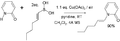 Chan-Lam coupling


