Hericium: Difference between revisions
CSV import Tags: mobile edit mobile web edit |
CSV import |
||
| Line 1: | Line 1: | ||
{{ | {{short description|Genus of fungi}} | ||
{{Taxobox | {{Taxobox | ||
| name = Hericium | | name = Hericium | ||
| image = | | image = Hericium_coralloides_-_Male_Karpaty_I.jpg | ||
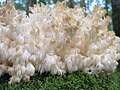
| image_caption = ''Hericium | | image_caption = ''Hericium coralloides'' | ||
| regnum = [[Fungi]] | | regnum = [[Fungi]] | ||
| divisio = [[Basidiomycota]] | | divisio = [[Basidiomycota]] | ||
| Line 10: | Line 10: | ||
| familia = [[Hericiaceae]] | | familia = [[Hericiaceae]] | ||
| genus = '''''Hericium''''' | | genus = '''''Hericium''''' | ||
| genus_authority = [[Pers.]] | | genus_authority = [[Christian Hendrik Persoon|Pers.]] | ||
}} | }} | ||
'''''Hericium''''' is a genus of [[fungi]] in the family [[Hericiaceae]]. These fungi are | '''''Hericium''''' is a genus of [[fungi]] in the family [[Hericiaceae]]. These fungi are known for their distinctive appearance, often resembling a cluster of icicles or a lion's mane. They are found in temperate forests and are known for their culinary and medicinal uses. | ||
==Description== | ==Description== | ||
''Hericium'' | ''Hericium'' species are characterized by their unique fruiting bodies, which consist of long, hanging spines. These spines are typically white or cream-colored, although they may discolor with age. The fruiting bodies are often found on dead or dying hardwood trees, where they play a role in the decomposition process. | ||
[[File:Soplówka_03_-_Centrum_Nauki_Kopernik_w_Warszawie.jpg|thumb|left|''Hericium erinaceus'' at the Copernicus Science Centre]] | |||
==Species== | ==Species== | ||
The genus ''Hericium'' includes several species, the | The genus ''Hericium'' includes several species, each with distinct characteristics: | ||
* '''''[[Hericium erinaceus]]''''', commonly known as the lion's mane mushroom, is notable for its use in traditional medicine and as a gourmet ingredient. | |||
* '''''[[Hericium coralloides]]''''', also known as the coral tooth fungus, is recognized by its branched, coral-like structure. | |||
* '''''[[Hericium abietis]]''''', found primarily in North America, grows on coniferous trees. | |||
* '''''[[Hericium americanum]]''''', similar to ''H. coralloides'', is distinguished by its longer spines. | |||
* '''''[[Hericium cirrhatum]]''''', or the tiered tooth fungus, is known for its layered appearance. | |||
* '''''[[Hericium clathroides]]''''', less commonly encountered, shares the icicle-like spines typical of the genus. | |||
[[File:Igelstachelbart,_Hericium_erinaceus.jpg|thumb|right|''Hericium erinaceus'']] | |||
== | ==Ecology== | ||
''Hericium'' species are saprotrophic, meaning they | ''Hericium'' species are saprotrophic, meaning they obtain nutrients by decomposing organic matter. They are typically found on hardwoods, such as oak, beech, and maple, although some species, like ''H. abietis'', prefer coniferous hosts. These fungi contribute to nutrient cycling in forest ecosystems by breaking down lignin and cellulose in wood. | ||
== | ==Uses== | ||
''Hericium'' mushrooms are valued for both culinary and medicinal purposes. ''Hericium erinaceus'' is particularly popular in Asian cuisine and is believed to have neuroprotective properties. It is used in traditional Chinese medicine to support cognitive health and improve digestive function. | |||
''Hericium'' | |||
[[File:Hericium_abietis_109093.jpg|thumb|left|''Hericium abietis'']] | |||
''Hericium'' | |||
==Cultivation== | ==Cultivation== | ||
''Hericium'' | Cultivation of ''Hericium'' species, especially ''H. erinaceus'', has become increasingly popular due to their health benefits and unique flavor. These mushrooms can be grown on sterilized sawdust or logs, and they require specific temperature and humidity conditions to fruit successfully. | ||
==Related pages== | ==Related pages== | ||
* [[Fungi]] | * [[Fungi]] | ||
* [[ | * [[Basidiomycota]] | ||
* [[ | * [[Agaricomycetes]] | ||
* [[ | * [[Russulales]] | ||
[[File:Hericium_americanum_Ginns_923240.jpg|thumb|right|''Hericium americanum'']] | |||
==Gallery== | |||
<gallery> | |||
File:Hericium_botryoides_GBIF_observation_2513152920_(cropped).jpg|''Hericium botryoides'' | |||
File:Mushroomtime_again^^_This_Hericium_cirrhatum_Syn._Creolophus_cirrhatus,_GB=_Tiered_Tooth_Fungus,_D=_Dorniger_stachelbart_Syn._Dorniger_Stachelseitling,_F=_Créolophe_ondulé,_NL=_Gelobde_pruikzwam)_grows_on_the_same_b_-_panoramio.jpg|''Hericium cirrhatum'' | |||
File:Hericium_clathroides_(Scop.)_Pers._(15689953975).jpg|''Hericium clathroides'' | |||
</gallery> | |||
[[Category:Hericiaceae]] | [[Category:Hericiaceae]] | ||
[[Category:Fungi genera]] | |||
[[Category:Edible fungi]] | [[Category:Edible fungi]] | ||
Latest revision as of 14:11, 21 February 2025
Genus of fungi
Hericium is a genus of fungi in the family Hericiaceae. These fungi are known for their distinctive appearance, often resembling a cluster of icicles or a lion's mane. They are found in temperate forests and are known for their culinary and medicinal uses.
Description[edit]
Hericium species are characterized by their unique fruiting bodies, which consist of long, hanging spines. These spines are typically white or cream-colored, although they may discolor with age. The fruiting bodies are often found on dead or dying hardwood trees, where they play a role in the decomposition process.

Species[edit]
The genus Hericium includes several species, each with distinct characteristics:
- Hericium erinaceus, commonly known as the lion's mane mushroom, is notable for its use in traditional medicine and as a gourmet ingredient.
- Hericium coralloides, also known as the coral tooth fungus, is recognized by its branched, coral-like structure.
- Hericium abietis, found primarily in North America, grows on coniferous trees.
- Hericium americanum, similar to H. coralloides, is distinguished by its longer spines.
- Hericium cirrhatum, or the tiered tooth fungus, is known for its layered appearance.
- Hericium clathroides, less commonly encountered, shares the icicle-like spines typical of the genus.

Ecology[edit]
Hericium species are saprotrophic, meaning they obtain nutrients by decomposing organic matter. They are typically found on hardwoods, such as oak, beech, and maple, although some species, like H. abietis, prefer coniferous hosts. These fungi contribute to nutrient cycling in forest ecosystems by breaking down lignin and cellulose in wood.
Uses[edit]
Hericium mushrooms are valued for both culinary and medicinal purposes. Hericium erinaceus is particularly popular in Asian cuisine and is believed to have neuroprotective properties. It is used in traditional Chinese medicine to support cognitive health and improve digestive function.

Cultivation[edit]
Cultivation of Hericium species, especially H. erinaceus, has become increasingly popular due to their health benefits and unique flavor. These mushrooms can be grown on sterilized sawdust or logs, and they require specific temperature and humidity conditions to fruit successfully.
Related pages[edit]

Gallery[edit]
-
 Hericium botryoides
 -
 Hericium cirrhatum
 -
 Hericium clathroides
.jpg)
_grows_on_the_same_b_-_panoramio.jpg)
_Pers._(15689953975).jpg)
