Fluorodeoxyglucose (18F): Difference between revisions
CSV import Tags: mobile edit mobile web edit |
CSV import |
||
| Line 39: | Line 39: | ||
[[Category:Medical imaging]] | [[Category:Medical imaging]] | ||
[[Category:Fluorine compounds]] | [[Category:Fluorine compounds]] | ||
<gallery> | |||
File:Fluorodeoxyglucose 18-F skeletal.svg|Fluorodeoxyglucose (18F) | |||
File:Synthesis of 18FDG.png|Synthesis of 18FDG | |||
File:PET-MIPS-anim.gif|PET MIPS Animation | |||
</gallery> | |||
Latest revision as of 01:20, 20 February 2025
A radiopharmaceutical used in medical imaging
Fluorodeoxyglucose (18F), commonly abbreviated as FDG, is a radiopharmaceutical used in positron emission tomography (PET) imaging. It is a glucose analog in which the hydroxyl group on the 2' carbon of the glucose molecule is replaced by the radioactive isotope fluorine-18. This modification allows FDG to be used as a tracer in PET scans to assess glucose metabolism in tissues.
Chemical Properties[edit]
FDG is a derivative of glucose, specifically a fluorinated analog. The substitution of the hydroxyl group with fluorine-18 makes it a suitable tracer for imaging because it mimics glucose uptake in cells but is not metabolized in the same way. The chemical formula for FDG is C6H11FO5, and it has a molecular weight of approximately 181.1 g/mol.
Mechanism of Action[edit]
FDG is taken up by cells via glucose transporters, similar to glucose. Once inside the cell, it is phosphorylated by hexokinase to FDG-6-phosphate. However, unlike glucose-6-phosphate, FDG-6-phosphate is not a substrate for further metabolism in the glycolytic pathway. This leads to its accumulation in cells, allowing for imaging of metabolic activity.
Clinical Applications[edit]
FDG is primarily used in PET imaging to evaluate metabolic activity in tissues. It is particularly useful in oncology, neurology, and cardiology.
Oncology[edit]
In oncology, FDG-PET is used to detect and monitor various types of cancer. Tumors often exhibit increased glucose metabolism, leading to higher uptake of FDG. This property allows for the detection of primary tumors, metastases, and the assessment of treatment response.
Neurology[edit]
In neurology, FDG-PET is used to study brain metabolism. It is valuable in the diagnosis and management of epilepsy, Alzheimer's disease, and other neurodegenerative disorders. Areas of altered glucose metabolism can indicate regions of the brain affected by disease.
Cardiology[edit]
In cardiology, FDG-PET helps assess myocardial viability. It can differentiate between viable and non-viable myocardial tissue in patients with ischemic heart disease.
Production[edit]
FDG is produced in a cyclotron where fluorine-18 is generated by bombarding oxygen-18 enriched water with protons. The fluorine-18 is then chemically incorporated into a glucose analog through a series of synthesis steps. Due to the short half-life of fluorine-18 (approximately 110 minutes), FDG must be produced and used quickly.
Safety and Precautions[edit]
FDG is generally safe when used in medical imaging, but as with all radiopharmaceuticals, it involves exposure to radiation. The amount of radiation is relatively low and is considered safe for diagnostic purposes. However, precautions are taken to minimize exposure to patients and healthcare workers.
Related pages[edit]
-
 Fluorodeoxyglucose (18F)
 -
 Synthesis of 18FDG
 -
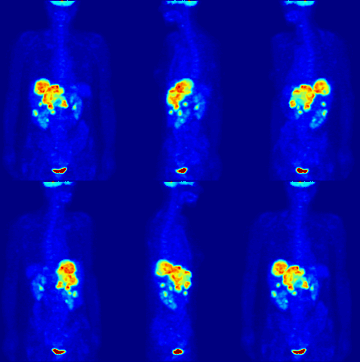 PET MIPS Animation


