American bullfrog: Difference between revisions
CSV import |
CSV import |
||
| Line 10: | Line 10: | ||
File:Supermarktfrosch.jpg|American bullfrog | File:Supermarktfrosch.jpg|American bullfrog | ||
</gallery> | </gallery> | ||
==American Bullfrog== | |||
The '''American bullfrog''' (''Lithobates catesbeianus''), also known as the '''North American bullfrog''', is a large species of frog native to North America. It is known for its distinctive call and its role as both a predator and prey in its ecosystem. | |||
==Description== | |||
The American bullfrog is the largest frog in North America, with adults typically measuring 3.5 to 6 inches in body length. They have a robust body, a wide mouth, and powerful hind legs adapted for jumping. The skin is generally green or brown with darker mottling, and the belly is white or yellowish. | |||
==Habitat== | |||
American bullfrogs are highly adaptable and can be found in a variety of freshwater habitats, including ponds, lakes, marshes, and slow-moving streams. They prefer warm, shallow waters with abundant vegetation. | |||
==Diet== | |||
Bullfrogs are opportunistic feeders and have a diverse diet. They primarily consume insects, but they are also known to eat small fish, other amphibians, and even small birds and mammals. Their diet can vary significantly depending on the availability of prey in their environment. | |||
==Reproduction== | |||
Breeding occurs in the warmer months, typically from late spring to early summer. Males call to attract females, producing a deep, resonant "jug-o-rum" sound. Females lay eggs in large, floating masses, which can contain thousands of eggs. Tadpoles hatch from the eggs and undergo metamorphosis over several months to become adult frogs. | |||
==Distribution== | |||
The American bullfrog is native to the eastern United States and parts of Canada. However, it has been introduced to many other regions, including the western United States, Europe, Asia, and South America, where it is often considered an invasive species. | |||
==Ecological Impact== | |||
As an invasive species, the American bullfrog can have significant ecological impacts. It competes with native amphibians for food and habitat and can be a voracious predator of native species. This has led to declines in some native amphibian populations in areas where bullfrogs have been introduced. | |||
==Conservation== | |||
While the American bullfrog is not considered threatened in its native range, its introduction to non-native areas poses challenges for conservation efforts. Management strategies often focus on controlling populations in areas where they are invasive to protect native species and ecosystems. | |||
==Related Pages== | |||
* [[Amphibian]] | |||
* [[Invasive species]] | |||
* [[Ecosystem]] | |||
* [[Metamorphosis]] | |||
{{Amphibians}} | |||
[[Category:Amphibians of North America]] | |||
[[Category:Invasive species]] | |||
[[Category:Ranidae]] | |||
Latest revision as of 00:38, 19 February 2025
-
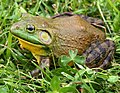 American bullfrog
 -
 American bullfrog
 -
 American bullfrog
 -
 American bullfrog tadpole stage
 -
 Juvenile American bullfrog
 -
 American bullfrog
 -
 American bullfrog
 -
 Alligator with American bullfrog
 -
 American bullfrog


_(6220036343).png)


American Bullfrog[edit]
The American bullfrog (Lithobates catesbeianus), also known as the North American bullfrog, is a large species of frog native to North America. It is known for its distinctive call and its role as both a predator and prey in its ecosystem.
Description[edit]
The American bullfrog is the largest frog in North America, with adults typically measuring 3.5 to 6 inches in body length. They have a robust body, a wide mouth, and powerful hind legs adapted for jumping. The skin is generally green or brown with darker mottling, and the belly is white or yellowish.
Habitat[edit]
American bullfrogs are highly adaptable and can be found in a variety of freshwater habitats, including ponds, lakes, marshes, and slow-moving streams. They prefer warm, shallow waters with abundant vegetation.
Diet[edit]
Bullfrogs are opportunistic feeders and have a diverse diet. They primarily consume insects, but they are also known to eat small fish, other amphibians, and even small birds and mammals. Their diet can vary significantly depending on the availability of prey in their environment.
Reproduction[edit]
Breeding occurs in the warmer months, typically from late spring to early summer. Males call to attract females, producing a deep, resonant "jug-o-rum" sound. Females lay eggs in large, floating masses, which can contain thousands of eggs. Tadpoles hatch from the eggs and undergo metamorphosis over several months to become adult frogs.
Distribution[edit]
The American bullfrog is native to the eastern United States and parts of Canada. However, it has been introduced to many other regions, including the western United States, Europe, Asia, and South America, where it is often considered an invasive species.
Ecological Impact[edit]
As an invasive species, the American bullfrog can have significant ecological impacts. It competes with native amphibians for food and habitat and can be a voracious predator of native species. This has led to declines in some native amphibian populations in areas where bullfrogs have been introduced.
Conservation[edit]
While the American bullfrog is not considered threatened in its native range, its introduction to non-native areas poses challenges for conservation efforts. Management strategies often focus on controlling populations in areas where they are invasive to protect native species and ecosystems.
Related Pages[edit]
| Extant amphibian positions by subclass | ||
|---|---|---|
|
