Molecular symmetry: Difference between revisions
CSV import |
CSV import |
||
| Line 34: | Line 34: | ||
[[Category:Molecular geometry]] | [[Category:Molecular geometry]] | ||
{{Chem-stub}} | {{Chem-stub}} | ||
<gallery> | |||
File:Formaldehyde_symmetry_elements.svg|Molecular_symmetry | |||
File:Chiral_sym_CHXYZ.svg|Molecular_symmetry | |||
File:Chiral_sym_CHXYRYS.svg|Molecular_symmetry | |||
File:Chiral_sym_CCXRYRXSYS.svg|Molecular_symmetry | |||
File:Chiral_sym_CCCXYXY.svg|Molecular_symmetry | |||
File:Chiral_sym_CHHXX.svg|Molecular_symmetry | |||
File:Chiral_sym_CCXYXY.svg|Molecular_symmetry | |||
File:Point_group_and_elements.png|Molecular_symmetry | |||
File:Xenon-tetrafluoride-3D-vdW.png|Molecular_symmetry | |||
File:Rotation-Reflection_operations_for_SF6.png|Molecular_symmetry | |||
File:Improper_rotation_S4.png|Molecular_symmetry | |||
File:C2v_point_group.png|Molecular_symmetry | |||
</gallery> | |||
== Molecular_symmetry == | |||
<gallery> | <gallery> | ||
File:Formaldehyde_symmetry_elements.svg|Molecular_symmetry | File:Formaldehyde_symmetry_elements.svg|Molecular_symmetry | ||
Latest revision as of 12:12, 18 February 2025
Molecular symmetry in chemistry involves the study of the symmetry features of molecules and their classification based on the presence of molecular symmetry operations and symmetry elements. Understanding molecular symmetry is crucial for explaining physical properties, reactivity, and spectroscopy of molecules. It plays a fundamental role in the development of molecular orbital theory, group theory, and the practice of spectroscopy and crystallography.
Symmetry Elements and Operations[edit]
Molecular symmetry is determined by the presence of various symmetry elements and the corresponding symmetry operations that can be performed on the molecule without altering its overall appearance. The primary symmetry elements include:
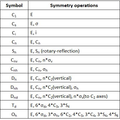
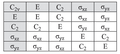
- Point Groups: The complete set of symmetry operations that define the symmetry of a molecule, classified into several types such as linear, spherical, and discrete point groups.
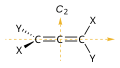
- Axes of rotation (C_n): An imaginary line around which a molecule can be rotated by 360°/n without changing its appearance, where n is the order of the axis.
- Planes of symmetry (σ): Imaginary planes that bisect a molecule in such a way that one half is the mirror image of the other.
- Center of symmetry (i): A point in the molecule from which all parts of the molecule are equidistant and inverted.
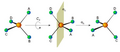
- Improper rotation axis (S_n): A combination of a rotation about an axis followed by a reflection through a plane perpendicular to that axis.
Importance of Molecular Symmetry[edit]
Molecular symmetry has profound implications in various areas of chemistry and physics:
- Spectroscopy: Symmetry determines the activity of molecules in different regions of the electromagnetic spectrum, influencing their infrared, Raman, and NMR spectra.
- Chemical reactivity: Symmetry considerations can predict the feasibility of certain reactions and the formation of products based on the conservation of symmetry.
- Molecular orbital theory: Symmetry helps in the construction of molecular orbitals, predicting the bonding and properties of molecules.
- Crystallography: The symmetry of molecules influences the packing and structure of crystals, affecting their physical properties.
Group Theory and Molecular Symmetry[edit]
Group theory provides a mathematical framework to study molecular symmetry. Molecules are classified into point groups based on their symmetry elements, which helps in predicting physical and chemical properties. The application of group theory simplifies the understanding of molecular vibrations, electronic states, and transitions.
Applications[edit]
Molecular symmetry is applied in the design of chiral drugs in pharmaceutical chemistry, the development of materials with specific optical properties in materials science, and the understanding of complex reactions in organic chemistry and inorganic chemistry.
See Also[edit]

-
 Molecular_symmetry
 -
 Molecular_symmetry
 -
 Molecular_symmetry
 -
 Molecular_symmetry
 -
 Molecular_symmetry
 -
 Molecular_symmetry
 -
 Molecular_symmetry
 -
 Molecular_symmetry
 -
 Molecular_symmetry
 -
 Molecular_symmetry
 -
 Molecular_symmetry
 -
 Molecular_symmetry


Molecular_symmetry[edit]
-
Molecular_symmetry
-
Molecular_symmetry
-
Molecular_symmetry
-
Molecular_symmetry
-
Molecular_symmetry
-
Molecular_symmetry
-
Molecular_symmetry
-
Molecular_symmetry
-
Molecular_symmetry
-
Molecular_symmetry
-
Molecular_symmetry
-
Molecular_symmetry
