Bromic acid: Difference between revisions
CSV import |
No edit summary |
||
| Line 22: | Line 22: | ||
[[Category:Oxidizing agents]] | [[Category:Oxidizing agents]] | ||
{{Chemistry-stub}} | {{Chemistry-stub}} | ||
<gallery> | <gallery> | ||
File:Bromic_acid.svg|Diagram of Bromic Acid | File:Bromic_acid.svg|Diagram of Bromic Acid | ||
File:Bromic-acid-3D-vdW.png|3D van der Waals model of Bromic Acid | File:Bromic-acid-3D-vdW.png|3D van der Waals model of Bromic Acid | ||
</gallery> | </gallery> | ||
Latest revision as of 19:12, 16 March 2025
Bromic acid is a strong acid that is formed when bromine reacts with water. It is a powerful oxidizing agent and is commonly used in laboratories for various chemical reactions.
Chemical Properties[edit]
Bromic acid is a strong acid that is highly corrosive. It has a pungent odor and is a powerful oxidizing agent. It reacts with most metals and nonmetals, and it can cause severe burns if it comes into contact with skin or eyes.
Physical Properties[edit]
Bromic acid is a colorless liquid at room temperature. It has a boiling point of 49 degrees Celsius and a melting point of -66 degrees Celsius. It is soluble in water and alcohol.
Uses[edit]
Bromic acid is used in laboratories for various chemical reactions. It is also used in the production of bromates, which are used in the textile industry as bleaching agents. In addition, bromic acid is used in the production of pharmaceuticals and in the synthesis of other chemicals.
Safety[edit]
Bromic acid is a highly corrosive substance that can cause severe burns if it comes into contact with skin or eyes. It is also a powerful oxidizing agent, which means it can cause fires or explosions if it comes into contact with combustible materials. Therefore, it should be handled with care and stored in a cool, dry place away from combustible materials.
See Also[edit]

-
 Diagram of Bromic Acid
 -
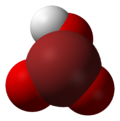 3D van der Waals model of Bromic Acid


