Armophorea: Difference between revisions
CSV import Tags: mobile edit mobile web edit |
CSV import |
||
| Line 3: | Line 3: | ||
File:Parasite180015-fig1_Sicuophora_multigranularis_(Armophorea,_Clevelandellida).png|Sicuophora multigranularis (Armophorea, Clevelandellida) | File:Parasite180015-fig1_Sicuophora_multigranularis_(Armophorea,_Clevelandellida).png|Sicuophora multigranularis (Armophorea, Clevelandellida) | ||
</gallery> | </gallery> | ||
== Armophorea == | |||
'''Armophorea''' is a class of [[ciliate]]s, which are a group of [[protozoa]] characterized by the presence of hair-like organelles called [[cilia]]. These cilia are used for movement and feeding. Armophorea is notable for its members' adaptation to anaerobic environments, where they often play a role in the decomposition of organic matter. | |||
=== Characteristics === | |||
Members of the class Armophorea are distinguished by their unique cellular structures and metabolic processes. They typically possess a reduced or absent [[mitochondrion]], which is replaced by hydrogenosomes or other organelles adapted to anaerobic respiration. This adaptation allows them to thrive in environments devoid of oxygen, such as the sediments of freshwater and marine ecosystems. | |||
The cilia of Armophorea are arranged in rows or spirals, and they are used for locomotion and feeding. These organisms often have a complex oral apparatus that aids in the ingestion of food particles, which are primarily bacteria and other small microorganisms. | |||
=== Taxonomy === | |||
The class Armophorea is divided into several orders, with the most notable being: | |||
* '''[[Armophorida]]''': This order includes genera such as ''[[Metopus]]'' and ''[[Caenomorpha]]'', which are commonly found in anaerobic environments. | |||
* '''[[Clevelandellida]]''': Members of this order are often symbionts in the intestines of [[herbivorous]] animals, where they aid in the digestion of cellulose. | |||
=== Ecology === | |||
Armophorea play a crucial role in the ecosystems they inhabit. By breaking down organic matter in anaerobic conditions, they contribute to the recycling of nutrients. In symbiotic relationships, such as those with herbivores, they assist in the digestion of plant material, facilitating the host's access to nutrients. | |||
These ciliates are also important indicators of environmental conditions, as their presence and abundance can reflect the oxygen levels and organic content of their habitats. | |||
== Related pages == | |||
* [[Ciliate]] | |||
* [[Protozoa]] | |||
* [[Anaerobic respiration]] | |||
* [[Symbiosis]] | |||
{{Ciliates}} | |||
[[Category:Ciliates]] | |||
[[Category:Protozoa]] | |||
[[Category:Anaerobic organisms]] | |||
Latest revision as of 00:39, 19 February 2025
Armophorea Parasite[edit]
-
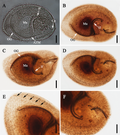 Sicuophora multigranularis (Armophorea, Clevelandellida)
.png)
Armophorea[edit]
Armophorea is a class of ciliates, which are a group of protozoa characterized by the presence of hair-like organelles called cilia. These cilia are used for movement and feeding. Armophorea is notable for its members' adaptation to anaerobic environments, where they often play a role in the decomposition of organic matter.
Characteristics[edit]
Members of the class Armophorea are distinguished by their unique cellular structures and metabolic processes. They typically possess a reduced or absent mitochondrion, which is replaced by hydrogenosomes or other organelles adapted to anaerobic respiration. This adaptation allows them to thrive in environments devoid of oxygen, such as the sediments of freshwater and marine ecosystems.
The cilia of Armophorea are arranged in rows or spirals, and they are used for locomotion and feeding. These organisms often have a complex oral apparatus that aids in the ingestion of food particles, which are primarily bacteria and other small microorganisms.
Taxonomy[edit]
The class Armophorea is divided into several orders, with the most notable being:
- Armophorida: This order includes genera such as Metopus and Caenomorpha, which are commonly found in anaerobic environments.
- Clevelandellida: Members of this order are often symbionts in the intestines of herbivorous animals, where they aid in the digestion of cellulose.
Ecology[edit]
Armophorea play a crucial role in the ecosystems they inhabit. By breaking down organic matter in anaerobic conditions, they contribute to the recycling of nutrients. In symbiotic relationships, such as those with herbivores, they assist in the digestion of plant material, facilitating the host's access to nutrients.
These ciliates are also important indicators of environmental conditions, as their presence and abundance can reflect the oxygen levels and organic content of their habitats.
Related pages[edit]
| Ciliates | ||||||||
|---|---|---|---|---|---|---|---|---|
|
