Chromo shadow domain: Difference between revisions
No edit summary |
CSV import Tags: mobile edit mobile web edit |
||
| Line 21: | Line 21: | ||
[[Category:Protein domains]] | [[Category:Protein domains]] | ||
[[Category:Epigenetics]] | [[Category:Epigenetics]] | ||
== Chromo_shadow_domain == | |||
<gallery> | |||
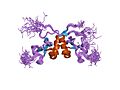
File:PDB_1s4z_EBI.jpg|PDB 1s4z EBI | |||
</gallery> | |||
Latest revision as of 00:37, 27 February 2025
The Chromo Shadow Domain is a protein domain that is crucial for the function of chromatin-associated proteins, particularly those involved in the regulation of gene expression and epigenetic modifications. This domain is a part of the chromodomain family, which is known for its role in recognizing and binding to specific histone modifications.
Structure[edit]
The Chromo Shadow Domain is characterized by its unique three-dimensional structure, which allows it to interact with other proteins and chromatin components. The structure typically consists of a beta-barrel fold that facilitates binding interactions. The image on the right shows the crystal structure of the Chromo Shadow Domain, highlighting its compact and stable configuration.
Function[edit]
The primary function of the Chromo Shadow Domain is to mediate protein-protein interactions. It is often found in proteins that are part of the Polycomb group proteins, which are involved in maintaining the repressed state of genes through chromatin remodeling. The domain allows these proteins to form complexes that can effectively modify chromatin structure and influence gene expression patterns.
Biological Significance[edit]
The Chromo Shadow Domain plays a significant role in the regulation of developmental genes and is essential for maintaining cell identity. By participating in the formation of repressive chromatin structures, it helps ensure that genes are expressed in a controlled manner, which is crucial for normal development and cellular differentiation.
Interactions[edit]
Proteins containing the Chromo Shadow Domain often interact with other chromatin-associated proteins, such as histone deacetylases and DNA methyltransferases. These interactions are vital for the establishment and maintenance of heterochromatin, a tightly packed form of DNA that is transcriptionally inactive.
Related Pages[edit]
Chromo_shadow_domain[edit]
-
 PDB 1s4z EBI

