Agrobacterium tumefaciens: Difference between revisions
CSV import |
CSV import |
||
| Line 52: | Line 52: | ||
[[Category:Plant pathogens and diseases]] | [[Category:Plant pathogens and diseases]] | ||
[[Category:Genetic engineering]] | [[Category:Genetic engineering]] | ||
== Agrobacterium_tumefaciens == | |||
<gallery> | |||
File:Agrobacterium-tumefaciens.png|Agrobacterium tumefaciens | |||
File:Transfection_by_Agrobacterium.svg|Transfection by Agrobacterium | |||
File:Transformation_with_Agrobacterium.JPG|Transformation with Agrobacterium | |||
File:A_tumefaciens_disease_cycle.jpg|A. tumefaciens disease cycle | |||
File:Crown_Gall_of_Sunflower.jpg|Crown Gall of Sunflower | |||
</gallery> | |||
Latest revision as of 04:27, 18 February 2025
Agrobacterium tumefaciens[edit]
Agrobacterium tumefaciens is a Gram-negative bacterium that is well known for its ability to transfer DNA to plants, causing crown gall disease. This bacterium is a member of the family Rhizobiaceae and is closely related to other plant-associated bacteria.
Biology[edit]
Agrobacterium tumefaciens is a rod-shaped, motile bacterium that is found in the soil. It is an aerobic organism that can utilize a variety of carbon sources. The bacterium is characterized by its ability to transfer a segment of its DNA, known as the T-DNA, into the genome of a host plant. This process is facilitated by the Ti plasmid, which carries the genes necessary for DNA transfer and integration.
Mechanism of DNA Transfer[edit]
The process of DNA transfer begins when Agrobacterium tumefaciens attaches to a wound site on a plant. The bacterium senses plant-derived signals, such as phenolic compounds, which activate the virulence genes on the Ti plasmid. These genes encode proteins that mediate the transfer of T-DNA into the plant cell. Once inside the plant cell, the T-DNA is integrated into the plant genome, leading to the expression of genes that cause the formation of a tumor-like growth known as a crown gall.
Applications in Biotechnology[edit]
Agrobacterium tumefaciens has been harnessed as a tool for genetic engineering in plants. By replacing the tumor-inducing genes on the T-DNA with genes of interest, scientists can introduce new traits into plants. This method is widely used in the development of genetically modified organisms (GMOs) and has applications in agriculture, such as the development of herbicide-resistant and pest-resistant crops.
Disease Cycle[edit]
The disease cycle of Agrobacterium tumefaciens begins with the bacterium's entry into a plant through a wound. Once inside, the bacterium transfers its T-DNA into the plant cells, leading to the formation of crown galls. These galls provide a niche for the bacteria to proliferate and spread to other plants. The cycle continues as the bacteria are released into the soil from decaying plant material, where they can infect new hosts.
Crown Gall Disease[edit]
Crown gall disease is characterized by the formation of large, tumor-like growths at the site of infection. These galls can disrupt the normal growth and development of the plant, leading to reduced vigor and yield. The disease affects a wide range of plant species, including many economically important crops such as grapevines, stone fruits, and ornamentals.
Related Pages[edit]
Gallery[edit]
-
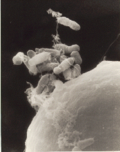 Agrobacterium tumefaciens
 -
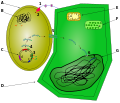 Mechanism of DNA transfer
 -
 Transformation of plants
 -
 Disease cycle
 -
 Crown gall on sunflower


Agrobacterium_tumefaciens[edit]
-
Agrobacterium tumefaciens
-
Transfection by Agrobacterium
-
Transformation with Agrobacterium
-
A. tumefaciens disease cycle
-
Crown Gall of Sunflower
