Advanced airway management: Difference between revisions
CSV import |
CSV import |
||
| Line 73: | Line 73: | ||
[[Category:Anesthesia]] | [[Category:Anesthesia]] | ||
[[Category:Intensive care medicine]] | [[Category:Intensive care medicine]] | ||
<gallery> | |||
File:Glidescope_02.JPG|Glidescope used for advanced airway management | |||
File:Airway_oral_keeping_the_airway_open_in_an_unconscious_patient.jpg|Keeping the airway open in an unconscious patient | |||
File:Intubasion_boru.jpg|Intubation tube | |||
File:ETTubeandNGtubeMarked.png|Endotracheal tube and nasogastric tube | |||
File:Larynxmikro2.jpg|Larynx viewed with a microscope | |||
File:Larynx_external_en.svg|External view of the larynx | |||
File:Premature_infant_with_ventilator.jpg|Premature infant with ventilator | |||
</gallery> | |||
Latest revision as of 11:11, 18 February 2025
Advanced airway management[edit]

Advanced airway management is a set of medical procedures performed to ensure an open airway in patients who are unable to maintain a patent airway on their own. This is a critical skill in emergency medicine, anesthesia, and intensive care medicine.
Techniques[edit]
Advanced airway management involves several techniques, including:
Endotracheal intubation[edit]

Endotracheal intubation is the placement of a tube into the trachea through the mouth or nose to maintain an open airway. This is often performed using a laryngoscope to visualize the vocal cords and guide the tube into the trachea.
Supraglottic airway devices[edit]
Supraglottic airway devices, such as the laryngeal mask airway (LMA), are used to maintain an open airway without entering the trachea. These devices sit above the glottis and are less invasive than endotracheal intubation.
Cricothyrotomy[edit]
A cricothyrotomy is an emergency procedure where an incision is made through the skin and cricothyroid membrane to establish an airway. This is typically performed when other methods of airway management are not possible.
Tracheostomy[edit]
A tracheostomy involves creating a direct airway through an incision in the trachea. This is usually a more permanent solution for patients who require long-term ventilation.
Equipment[edit]
Advanced airway management requires specialized equipment, including:
Indications[edit]
Advanced airway management is indicated in situations where a patient is unable to maintain an open airway due to:
Complications[edit]
Complications of advanced airway management can include:
Related pages[edit]
Gallery[edit]
-
 Oral airway management in an unconscious patient.
 -
 Endotracheal tube and nasogastric tube.
 -
 Microscopic view of the larynx.
 -
 Diagram of the external anatomy of the larynx.
 -
 Premature infant on a ventilator.


-
 Glidescope used for advanced airway management
 -
Keeping the airway open in an unconscious patient
-
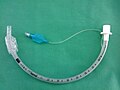 Intubation tube
 -
Endotracheal tube and nasogastric tube
-
Larynx viewed with a microscope
-
External view of the larynx
-
Premature infant with ventilator
