Ackee: Difference between revisions
CSV import |
CSV import |
||
| Line 44: | Line 44: | ||
[[Category:Jamaican cuisine]] | [[Category:Jamaican cuisine]] | ||
[[Category:Sapindaceae]] | [[Category:Sapindaceae]] | ||
<gallery> | |||
File:Ackee_001.jpg|Ackee | |||
File:2013.11-411-172_Akee,leaves(e-s)_Bobo-Dioulasso,BF_thu14nov2013-1025h.jpg|Ackee leaves | |||
File:Ackee_Flower_001.JPG|Ackee flower | |||
File:Akee.jpg|Ackee | |||
File:2013.11-411-155_Akee,fruit(e-s),seed&aril_Bobo-Dioulasso,BF_sun10nov2013-1740h.jpg|Ackee fruit, seed and aril | |||
File:2013.11-411-169_Akee,fruit(part),seed&aril(i-s)_Bobo-Dioulasso,BF_thu14nov2013-0953h.jpg|Ackee fruit part, seed and aril | |||
File:2013.11-411-169_Akee,seed&aril(whole,LS)_Bobo-Dioulasso,BF_thu14nov2013-0953h.jpg|Ackee seed and aril whole | |||
File:Ackee_and_Saltfish.jpg|Ackee and saltfish | |||
File:Hypoglycin_A.svg|Hypoglycin A | |||
</gallery> | |||
Latest revision as of 11:55, 18 February 2025
Ackee[edit]

The ackee (Blighia sapida) is a tropical fruit native to West Africa. It is a member of the Sapindaceae family, which also includes the lychee and longan. The ackee is notable for its role in Jamaican cuisine, particularly in the national dish, ackee and saltfish.
Description[edit]
The ackee tree is an evergreen that grows about 10 meters tall. It has leathery, compound leaves and produces clusters of small, greenish-white flowers. The fruit is pear-shaped and turns from green to a bright red or yellow-orange when ripe. The fruit splits open to reveal three large, shiny black seeds surrounded by soft, creamy-white to yellow flesh known as the aril.
Toxicity[edit]
The unripe ackee fruit contains high levels of hypoglycin A, a toxin that can cause Jamaican vomiting sickness, a potentially fatal illness. The fruit is safe to eat only when it is fully ripe and has naturally opened on the tree. The arils must be properly cleaned and cooked before consumption.
Culinary Uses[edit]
Ackee is a staple in Jamaican cuisine. The arils are boiled and often cooked with saltfish, onions, tomatoes, and spices to make the traditional dish ackee and saltfish. The fruit is also used in soups and other savory dishes.
Cultivation[edit]
Ackee is cultivated in tropical and subtropical regions around the world. It thrives in well-drained soils and requires a warm climate. The tree is propagated by seeds, which take several years to bear fruit.
Gallery[edit]
-
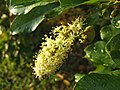 Ackee flower
 -
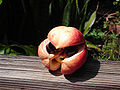 Ackee fruit
 -
 Ackee fruit with seed and aril
 -
 Ackee fruit part with seed and aril
 -
 Ackee seed and aril


,seed%26aril_Bobo-Dioulasso,BF_sun10nov2013-1740h.jpg)
,seed%26aril(i-s)_Bobo-Dioulasso,BF_thu14nov2013-0953h.jpg)
_Bobo-Dioulasso,BF_thu14nov2013-0953h.jpg)
Related pages[edit]
-
 Ackee
Ackee -
 Ackee leaves
 -
Ackee flower
-
Ackee
-
Ackee fruit, seed and aril
-
Ackee fruit part, seed and aril
-
Ackee seed and aril whole
-
 Ackee and saltfish
 -
 Hypoglycin A
_Bobo-Dioulasso,BF_thu14nov2013-1025h.jpg)


