Acromial angle: Difference between revisions
CSV import |
CSV import |
||
| Line 31: | Line 31: | ||
[[Category:Anatomy of the upper limb]] | [[Category:Anatomy of the upper limb]] | ||
<gallery> | |||
File:Acromial_angle_of_left_scapula01.png|Acromial angle of left scapula | |||
File:Acromial_angle_of_scapula04.png|Acromial angle of scapula | |||
File:Acromial_angle_of_left_scapula_-_animation01.gif|Acromial angle of left scapula - animation | |||
File:Acromial_angle_of_scapula_-_animation01.gif|Acromial angle of scapula - animation | |||
File:Scapula_post_-_acromial_angle_of_left_scapula.png|Scapula post - acromial angle of left scapula | |||
File:Acromial_angle_of_left_scapula04.png|Acromial angle of left scapula | |||
</gallery> | |||
Latest revision as of 11:29, 18 February 2025
Anatomical feature of the scapula
The acromial angle is a prominent anatomical feature of the scapula, or shoulder blade, which plays a crucial role in the musculoskeletal system of the human body. It is located at the lateral end of the spine of the scapula, where the spine meets the acromion.
Anatomy[edit]
The acromial angle is formed by the junction of the spine of the scapula and the acromion. The acromion is a bony process on the scapula that extends laterally over the shoulder joint. The angle itself is palpable and can be used as a landmark in various medical examinations and procedures.
The acromial angle serves as an attachment point for several muscles and ligaments, contributing to the stability and movement of the shoulder joint. It is involved in the articulation with the clavicle at the acromioclavicular joint.
Function[edit]
The acromial angle is important for the function of the shoulder girdle. It provides leverage and support for the muscles that move the arm and shoulder. The deltoid muscle, which is responsible for lifting the arm, attaches to the acromion and utilizes the acromial angle for effective movement.
Clinical significance[edit]
The acromial angle is often examined in cases of shoulder injuries or conditions such as shoulder impingement syndrome. Variations in the shape and size of the acromial angle can affect the biomechanics of the shoulder and may contribute to certain pathologies.
Related pages[edit]
Gallery[edit]
-
 Acromial angle of left scapula
 -
 Acromial angle of scapula
 -
 Animation of acromial angle of left scapula
 -
 Animation of acromial angle of scapula
 -
 Posterior view of scapula showing acromial angle
 -
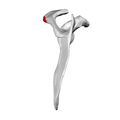 Acromial angle of left scapula


-
Acromial angle of left scapula
-
Acromial angle of scapula
-
Acromial angle of left scapula - animation
-
Acromial angle of scapula - animation
-
Scapula post - acromial angle of left scapula
-
Acromial angle of left scapula
