Acer pseudoplatanus: Difference between revisions
CSV import |
CSV import |
||
| Line 47: | Line 47: | ||
[[Category:Trees of Europe]] | [[Category:Trees of Europe]] | ||
[[Category:Ornamental trees]] | [[Category:Ornamental trees]] | ||
<gallery> | |||
File:Acer_pseudoplatanus_005.jpg|Acer pseudoplatanus | |||
File:Acer_pseudoplatanusAA.jpg|Acer pseudoplatanus | |||
File:Acer_pseudoplatanus_Chaltenbrunnen.jpg|Acer pseudoplatanus | |||
File:Ahornallee_zwischen_Altweitra_und_Hörmanns_2017-10.jpg|Acer pseudoplatanus | |||
File:Acer_pseudoplatanus_buds_01.jpg|Acer pseudoplatanus buds | |||
File:RhytismaAcerinumDetailU.jpg|Rhytisma acerinum detail | |||
File:Acer_pseudoplatanus_textura_del_tronco.jpg|Acer pseudoplatanus trunk texture | |||
File:The_Martyrs_tree_-_geograph.org.uk_-_1277399.jpg|The Martyrs tree | |||
</gallery> | |||
Latest revision as of 11:53, 18 February 2025
Acer pseudoplatanus[edit]


Acer pseudoplatanus, commonly known as the sycamore maple, is a species of maple native to Central Europe and Western Asia. It is a large deciduous tree that can grow up to 35 meters tall, with a broad, domed crown. The tree is widely planted as an ornamental and shade tree in urban areas and is valued for its hardiness and adaptability.
Description[edit]
Acer pseudoplatanus is characterized by its large, palmate leaves, which are typically 10–25 cm long and broad, with five lobes. The leaves are dark green on the upper surface and paler underneath. In autumn, the leaves turn a striking yellow or brown before falling.
The bark of the sycamore maple is smooth and grey when young, becoming rough and scaly with age. The tree produces small, greenish-yellow flowers in spring, which are arranged in pendulous racemes. The fruit is a double samara, with two winged seeds that are dispersed by the wind.
Distribution and Habitat[edit]
Acer pseudoplatanus is native to Europe and Western Asia, where it grows in a variety of habitats, including woodlands, riverbanks, and rocky slopes. It is tolerant of a wide range of soil types and conditions, including urban environments, where it is often planted as a street tree.
Ecological Importance[edit]
The sycamore maple provides habitat and food for a variety of wildlife. Its leaves are a food source for the larvae of several species of Lepidoptera, including the sycamore moth. The tree's flowers provide nectar for bees and other pollinators, while its seeds are eaten by birds and small mammals.
Uses[edit]
Acer pseudoplatanus is widely used in landscaping and forestry. Its wood is valued for its strength and workability, making it suitable for furniture, flooring, and musical instruments. The tree is also planted for its aesthetic appeal and ability to provide shade in urban areas.
Pests and Diseases[edit]
The sycamore maple is susceptible to several pests and diseases, including the sycamore aphid and tar spot disease, caused by the fungus Rhytisma acerinum. These can affect the tree's health and appearance but are rarely fatal.
Gallery[edit]
-
 Acer pseudoplatanus in a natural setting
 -
 Acer pseudoplatanus lining a road
 -
 Buds of Acer pseudoplatanus
 -
 Tar spot on Acer pseudoplatanus leaf
 -
 Bark texture of Acer pseudoplatanus
 -
 A notable Acer pseudoplatanus tree


Related pages[edit]
-
 Acer pseudoplatanus
 -
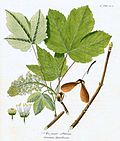 Acer pseudoplatanus
 -
Acer pseudoplatanus
-
Acer pseudoplatanus
-
Acer pseudoplatanus buds
-
Rhytisma acerinum detail
-
Acer pseudoplatanus trunk texture
-
The Martyrs tree
