3D printing: Difference between revisions
CSV import |
CSV import |
||
| Line 1: | Line 1: | ||
== 3D Printing == | == 3D Printing == | ||
[[File:Robot_3D_print_timelapse_on_RepRapPro_Fisher.gif|thumb|3D printing in action on a RepRapPro Fisher printer.]] | |||
'''3D printing''', also known as '''additive manufacturing''', is a process of making three-dimensional solid objects from a digital file. The creation of a 3D printed object is achieved using additive processes. In an additive process, an object is created by laying down successive layers of material until the object is complete. Each of these layers can be seen as a thinly sliced cross-section of the eventual object. | |||
== | == History == | ||
3D printing | The roots of 3D printing can be traced back to the 1980s. The first working 3D printer was created by [[Chuck Hull]] of 3D Systems Corp in 1984. Hull invented the [[stereolithography]] (SLA) process, a method that allows designers to create 3D models using digital data, which can then be used to create a physical object. | ||
== Technologies == | |||
3D printing encompasses a variety of processes and technologies. Some of the most common include: | |||
=== Fused Deposition Modeling (FDM) === | |||
[[File:Schematic_representation_of_Fused_Filament_Fabrication_01.png|thumb|Schematic representation of Fused Filament Fabrication.]] | |||
FDM is one of the most popular 3D printing technologies. It works by melting a plastic filament and extruding it layer by layer to build a model. This method is widely used due to its simplicity and cost-effectiveness. | |||
=== Stereolithography (SLA) === | |||
[[File:Schematic_representation_of_Stereolithography.png|thumb|Schematic representation of Stereolithography.]] | |||
SLA uses a laser to cure liquid resin into hardened plastic in a process called photopolymerization. This technology is known for its high precision and smooth surface finish. | |||
=== Selective Laser Sintering (SLS) === | |||
SLS uses a laser to sinter powdered material, binding it together to create a solid structure. This method is used for producing parts with complex geometries and is popular in industrial applications. | |||
== Applications == | |||
3D printing has a wide range of applications across various industries: | 3D printing has a wide range of applications across various industries: | ||
=== Medicine === | |||
3D printing is used to create customized prosthetics, implants, and even bioprinted tissues and organs. It allows for the production of patient-specific medical devices. | |||
=== Aerospace === | |||
The aerospace industry uses 3D printing to produce lightweight and complex parts that are difficult to manufacture using traditional methods. | |||
=== Automotive === | |||
[[File:I_robot_car.jpg|thumb|3D printed components in automotive design.]] | |||
In the automotive industry, 3D printing is used for prototyping, tooling, and even producing end-use parts. | |||
=== Fashion === | |||
[[File:Ted_Noten_Fashionista_in_green_2009.jpg|thumb|3D printed fashion accessory.]] | |||
Designers use 3D printing to create intricate and innovative fashion pieces that would be impossible to produce with traditional techniques. | |||
== Advantages and Limitations == | |||
3D printing offers several advantages, including the ability to create complex geometries, reduce waste, and customize products. However, it also has limitations such as slower production speeds compared to traditional manufacturing and limitations in material properties. | |||
== | == Future of 3D Printing == | ||
3D printing | The future of 3D printing is promising, with ongoing research into new materials, faster printing processes, and broader applications. As technology advances, 3D printing is expected to become more integrated into everyday manufacturing and consumer products. | ||
== Related Pages == | == Related Pages == | ||
* [[Additive | * [[Additive manufacturing]] | ||
* [[ | * [[Stereolithography]] | ||
* [[ | * [[Fused deposition modeling]] | ||
* [[ | * [[Selective laser sintering]] | ||
== Gallery == | == Gallery == | ||
<gallery> | <gallery> | ||
File:84530877_FillingSys_(9415669149).jpg|Industrial 3D printing setup. | File:84530877_FillingSys_(9415669149).jpg|Industrial 3D printing setup. | ||
File:Doob_NY_SOHO_3D_selfie_photo_booth_IMG_4939_FRD.jpg|3D selfie photo booth. | File:Doob_NY_SOHO_3D_selfie_photo_booth_IMG_4939_FRD.jpg|3D selfie photo booth. | ||
File:Hyperboloid_Print.ogv|Video of a hyperboloid being printed. | File:Hyperboloid_Print.ogv|Video of a hyperboloid being printed. | ||
File:3DBenchy_created_using_color_mixing_on_an_FDM_printer.jpg|3DBenchy printed using color mixing | File:3DBenchy_created_using_color_mixing_on_an_FDM_printer.jpg|3DBenchy model printed using color mixing. | ||
File:HCC_3D_printed_turbine_view_1.jpg|3D printed turbine. | File:HCC_3D_printed_turbine_view_1.jpg|3D printed turbine. | ||
File:3D_Printed_Ancient_Egyptian_Figurine.png|3D printed ancient Egyptian figurine. | File:3D_Printed_Ancient_Egyptian_Figurine.png|3D printed ancient Egyptian figurine. | ||
</gallery> | </gallery> | ||
[[Category:3D printing]] | [[Category:3D printing]] | ||
Latest revision as of 20:13, 11 February 2025
3D Printing[edit]

3D printing, also known as additive manufacturing, is a process of making three-dimensional solid objects from a digital file. The creation of a 3D printed object is achieved using additive processes. In an additive process, an object is created by laying down successive layers of material until the object is complete. Each of these layers can be seen as a thinly sliced cross-section of the eventual object.
History[edit]
The roots of 3D printing can be traced back to the 1980s. The first working 3D printer was created by Chuck Hull of 3D Systems Corp in 1984. Hull invented the stereolithography (SLA) process, a method that allows designers to create 3D models using digital data, which can then be used to create a physical object.
Technologies[edit]
3D printing encompasses a variety of processes and technologies. Some of the most common include:
Fused Deposition Modeling (FDM)[edit]

FDM is one of the most popular 3D printing technologies. It works by melting a plastic filament and extruding it layer by layer to build a model. This method is widely used due to its simplicity and cost-effectiveness.
Stereolithography (SLA)[edit]

SLA uses a laser to cure liquid resin into hardened plastic in a process called photopolymerization. This technology is known for its high precision and smooth surface finish.
Selective Laser Sintering (SLS)[edit]
SLS uses a laser to sinter powdered material, binding it together to create a solid structure. This method is used for producing parts with complex geometries and is popular in industrial applications.
Applications[edit]
3D printing has a wide range of applications across various industries:
Medicine[edit]
3D printing is used to create customized prosthetics, implants, and even bioprinted tissues and organs. It allows for the production of patient-specific medical devices.
Aerospace[edit]
The aerospace industry uses 3D printing to produce lightweight and complex parts that are difficult to manufacture using traditional methods.
Automotive[edit]

In the automotive industry, 3D printing is used for prototyping, tooling, and even producing end-use parts.
Fashion[edit]

Designers use 3D printing to create intricate and innovative fashion pieces that would be impossible to produce with traditional techniques.
Advantages and Limitations[edit]
3D printing offers several advantages, including the ability to create complex geometries, reduce waste, and customize products. However, it also has limitations such as slower production speeds compared to traditional manufacturing and limitations in material properties.
Future of 3D Printing[edit]
The future of 3D printing is promising, with ongoing research into new materials, faster printing processes, and broader applications. As technology advances, 3D printing is expected to become more integrated into everyday manufacturing and consumer products.
Related Pages[edit]
Gallery[edit]
-
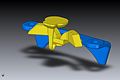 Industrial 3D printing setup.
 -
 3D selfie photo booth.
 -
 Video of a hyperboloid being printed.
 -
 3DBenchy model printed using color mixing.
 -
 3D printed turbine.
 -
 3D printed ancient Egyptian figurine.
.jpg)


