Army Medical Museum and Library: Difference between revisions
CSV import |
CSV import |
||
| Line 45: | Line 45: | ||
[[Category:Animal behavior]] | [[Category:Animal behavior]] | ||
<gallery> | |||
File:AMM4.jpg|Army Medical Museum and Library | |||
File:Army_Medical_Museum_and_Library.jpg|Army Medical Museum and Library | |||
File:SurgeonGeneral'sLibrary.jpg|Surgeon General's Library | |||
</gallery> | |||
Revision as of 03:48, 18 February 2025
Apparent Death
Apparent death, also known as thanatosis or tonic immobility, is a behavior observed in various animal species where an individual feigns death to evade predators. This anti-predator strategy is employed by a wide range of animals, including mammals, birds, reptiles, amphibians, and insects.
Mechanism
Apparent death is typically triggered by a threat or physical contact with a predator. The animal enters a state of immobility, often accompanied by a reduction in breathing and heart rate. This state can last from a few seconds to several minutes, depending on the species and the situation.
Examples in Nature
- Opossums are well-known for their dramatic display of thanatosis, often referred to as "playing possum." When threatened, an opossum will collapse, become limp, and emit a foul odor to mimic the scent of a decaying carcass.
- The Grass snake (Natrix natrix) is another example of a reptile that employs thanatosis. When threatened, it will roll onto its back, open its mouth, and may even release a foul-smelling substance to deter predators.
- The Phyllomedusa burmeisteri, a species of tree frog, can also exhibit tonic immobility when threatened, remaining motionless to avoid detection.
- The Common swift (Apus apus) may enter a state of apparent death when handled by humans, remaining still until the threat has passed.
- In the insect world, the Iridomyrmex purpureus, a type of ant, can feign death to avoid predation by other ants or larger predators.
- The Heterodon platirhinos, commonly known as the Eastern hognose snake, is famous for its elaborate death-feigning behavior, which includes convulsions and the release of a foul odor.
Evolutionary Advantages
The primary advantage of apparent death is to increase the likelihood of survival by deceiving predators into believing the prey is already dead and therefore not worth pursuing. This behavior can be particularly effective against predators that prefer live prey or are cautious of potential traps.
Related Behaviors
Apparent death is related to other anti-predator strategies such as camouflage, mimicry, and evasive maneuvers. Each of these strategies serves to reduce the likelihood of predation through different means.
Related Pages
Gallery
-
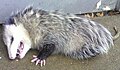 An opossum feigning death.
 -
 Grass snake playing dead.
 -
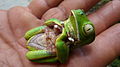 Phyllomedusa burmeisteri in a state of tonic immobility.
 -
 Common swift exhibiting apparent death.
 -
 Ants in a defensive posture.
 -
 Example of a bird species that may use thanatosis.
 -
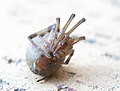 Spider in a state of thanatosis.
 -
 Eastern hognose snake feigning death.

_playing_dead_(14178349634).jpg)
.JPG)


-
 Army Medical Museum and Library
 -
 Army Medical Museum and Library
 -
 Surgeon General's Library


