Articular tubercle: Difference between revisions
CSV import |
CSV import |
||
| Line 43: | Line 43: | ||
[[Category:Feeding mechanisms]] | [[Category:Feeding mechanisms]] | ||
[[Category:Aquatic biology]] | [[Category:Aquatic biology]] | ||
== Articular_tubercle == | |||
<gallery> | |||
File:Articular_tubercle_of_temporal_bone_-_skull_-_lateral_view.png|Lateral view of the articular tubercle of the temporal bone | |||
File:Articular_tubercle_of_temporal_bone_-_skull_-_inferior_view03.png|Inferior view of the articular tubercle of the temporal bone | |||
</gallery> | |||
Revision as of 01:34, 18 February 2025
Aquatic Feeding Mechanisms
Aquatic feeding mechanisms refer to the diverse strategies and adaptations employed by aquatic organisms to capture and consume food in water environments. These mechanisms are crucial for survival and have evolved to exploit the unique properties of water, such as its density and viscosity. Aquatic feeding can be broadly categorized into several types, including filter feeding, suction feeding, ram feeding, and others.
Filter Feeding
Filter feeding is a method where organisms strain suspended matter and food particles from water. This is commonly seen in baleen whales, manta rays, and certain species of fish and invertebrates. Filter feeders often possess specialized structures such as baleen plates or gill rakers that allow them to efficiently capture food particles from the water column.
Suction Feeding
Suction feeding involves creating a negative pressure within the mouth to draw water and prey inside. This method is prevalent among many fish species, including groupers and seahorses. Suction feeding is highly effective in capturing prey that is close to the predator, as it allows for rapid intake of water and prey.
Ram Feeding
Ram feeding is characterized by the predator moving forward with its mouth open, engulfing prey along with water. This technique is used by species such as the manta ray and certain sharks. Ram feeding is advantageous for capturing fast-moving prey or when feeding in open water where prey is abundant.
Biting and Chewing
Some aquatic animals, such as certain species of fish and marine mammals, use biting and chewing to capture and process their food. This method involves the use of teeth or other hard structures to grasp and break down prey.
Specialized Feeding Mechanisms
Certain aquatic organisms have evolved unique feeding mechanisms to exploit specific niches. For example, the humpback whale uses a technique called bubble net feeding to corral and capture schools of fish. Seahorses, on the other hand, use a rapid snapping motion to capture small prey with their elongated snouts.
Related Pages
Gallery
-
 A giant grouper, an example of a suction feeder.
 -
 Manta ray demonstrating ram feeding.
 -
 Herring, often prey for larger filter feeders.
 -
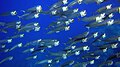 A school of fish, potential prey for various feeding mechanisms.
 -
 Humpback whale, known for bubble net feeding.
 -
 Seahorse, an example of a specialized feeder.
 -
 Krill, a common target for filter feeders.


Articular_tubercle
-
 Lateral view of the articular tubercle of the temporal bone
 -
 Inferior view of the articular tubercle of the temporal bone


