Larva currens: Difference between revisions
CSV import |
CSV import |
||
| Line 25: | Line 25: | ||
{{Medicine-stub}} | {{Medicine-stub}} | ||
{{No image}} | {{No image}} | ||
<gallery> | |||
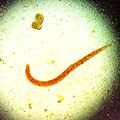
File:Strongyloides stercoralis.jpg|Larva currens | |||
</gallery> | |||
Revision as of 01:11, 20 February 2025
Larva currens is a distinctive skin condition characterized by a rapidly moving serpiginous rash, often associated with a strongyloidiasis infection. Strongyloidiasis is caused by the parasitic nematode Strongyloides stercoralis, which infects humans through contact with soil contaminated with the larvae. This condition is particularly notable for its rapid progression, as the rash can move at a speed of 5 to 10 centimeters per hour, distinguishing it from similar dermatological conditions caused by other parasites.
Etiology
Larva currens is primarily caused by the filariform larvae of Strongyloides stercoralis during their migration through the human body. After penetrating the skin, usually through the feet, the larvae travel through the bloodstream to the lungs. They then ascend the bronchial tree to the throat, are swallowed, and finally reach the small intestine, where they mature into adults. Some larvae, however, can cause an autoinfective cycle by penetrating the intestinal wall or perianal skin, leading to chronic infection and the potential for hyperinfection in immunocompromised individuals.
Clinical Presentation
The hallmark of larva currens is the rapidly moving, serpiginous, urticarial rash. It is often itchy and may be accompanied by symptoms of systemic infection, such as diarrhea, abdominal pain, cough, and wheezing, especially in cases of strongyloidiasis. The rash is most commonly found on the buttocks, thighs, and lower abdomen.
Diagnosis
Diagnosis of larva currens involves a combination of clinical presentation, history of exposure, and laboratory tests. Stool samples may be examined for the presence of S. stercoralis larvae, although multiple samples are often necessary due to the parasite's irregular shedding. Serological tests can also be helpful, especially in chronic or disseminated infections. In some cases, endoscopy and biopsy of the small intestine may be required to identify adult worms or larvae.
Treatment
The treatment of choice for larva currens and strongyloidiasis is ivermectin, which is effective in eliminating the infection in most cases. Alternative treatments include albendazole and thiabendazole, although these may be less effective. It is crucial to treat the condition promptly to prevent the hyperinfection syndrome, particularly in immunocompromised patients.
Prevention
Preventive measures for larva currens focus on avoiding contact with soil that may be contaminated with S. stercoralis. This includes wearing protective footwear when walking in endemic areas and implementing sanitation measures to reduce soil contamination.
Epidemiology
Larva currens is most commonly found in tropical and subtropical regions, where S. stercoralis is endemic. However, cases have been reported globally, including in temperate climates, due to increased travel and migration. Individuals at higher risk include those with a history of travel to endemic areas, military personnel, and individuals living in poor sanitary conditions.

-
 Larva currens

