Lazarakia: Difference between revisions
CSV import |
CSV import |
||
| Line 25: | Line 25: | ||
{{food-stub}} | {{food-stub}} | ||
{{No image}} | {{No image}} | ||
<gallery> | |||
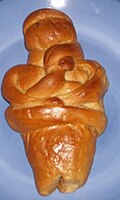
File:Lazarakia On Plate.jpg|Lazarakia | |||
</gallery> | |||
Revision as of 01:26, 20 February 2025
Lazarakia are small, spiced breads made in Greece on Lazarus Saturday, the Saturday that precedes Palm Sunday. They are a Greek Orthodox tradition and are shaped like Lazarus of Bethany, who was resurrected by Jesus Christ according to the New Testament.
History
The tradition of baking Lazarakia comes from the biblical story of Lazarus, who was resurrected by Jesus four days after his death. This miracle is commemorated by the Orthodox Church on Lazarus Saturday, and the baking of Lazarakia is a part of this celebration. The breads are often shaped to resemble Lazarus wrapped in a shroud, symbolizing his resurrection from the dead.
Preparation
Lazarakia are made from a spiced dough that often includes ingredients such as cinnamon, cloves, and anise. The dough is sweetened with honey and sometimes flavored with orange zest. After the dough is prepared, it is divided into pieces and shaped into figures representing Lazarus. The figures are then baked until they are golden brown.
Symbolism
The Lazarakia are symbolic of the resurrection of Lazarus and the promise of eternal life. They are often given to children as a reminder of this biblical story and the miracles of Jesus. The spices used in the dough are also symbolic, representing the spices used to anoint the body of Jesus after his death.
See also
This article is a Greek cuisine stub. You can help WikiMD by expanding it!

-
 Lazarakia

