Hopantenic acid: Difference between revisions
CSV import |
CSV import |
||
| Line 26: | Line 26: | ||
{{medicine-stub}} | {{medicine-stub}} | ||
{{No image}} | {{No image}} | ||
== Hopantenic_acid == | |||
<gallery> | |||
File:Hopantenic_acid.svg|Hopantenic acid structure | |||
File:Hopantenic_acid_ball-and-stick.png|Hopantenic acid ball-and-stick model | |||
</gallery> | |||
Revision as of 20:58, 25 February 2025
Hopantenic acid (also known as Pantogam, Pantocalm, Pantogam Active) is a derivative of pantothenic acid (vitamin B5) and gamma-aminobutyric acid (GABA). It is a nootropic compound that is used in some countries for the treatment of various neurological conditions.
Chemistry
Hopantenic acid is a racemic mixture of two stereoisomers. It is a white crystalline powder that is soluble in water. The chemical formula of hopantenic acid is C9H17NO5.
Pharmacology
Hopantenic acid is believed to work by increasing the activity of the neurotransmitter GABA in the brain. GABA is an inhibitory neurotransmitter, which means it reduces the activity of neurons in the brain. This can have a calming effect and reduce symptoms of anxiety and other neurological conditions.
Medical uses
In some countries, hopantenic acid is used for the treatment of various neurological conditions, including epilepsy, cerebral palsy, and cognitive impairment. It is also used to improve memory and cognitive function in people with mild cognitive impairment or dementia.
Side effects
The most common side effects of hopantenic acid are nausea, vomiting, and diarrhea. Other side effects can include dizziness, headache, and insomnia.
Research
There is ongoing research into the potential benefits of hopantenic acid for various conditions, including Alzheimer's disease, Parkinson's disease, and stroke. However, more research is needed to confirm these potential benefits.
See also

Hopantenic_acid
-
 Hopantenic acid structure
 -
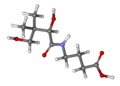 Hopantenic acid ball-and-stick model


