1,2-Dichloroethane: Difference between revisions
CSV import |
CSV import |
||
| Line 29: | Line 29: | ||
{{Chem-stub}} | {{Chem-stub}} | ||
{{No image}} | {{No image}} | ||
== 1,2-Dichloroethane gallery == | |||
<gallery> | |||
File:1,2-dichloroethane.svg|1,2-dichloroethane.svg | |||
File:1,2-dichloroethane-3D-vdW.png|1,2-dichloroethane-3D-vdW.png | |||
</gallery> | |||
Revision as of 04:55, 3 March 2025
1,2-Dichloroethane (1,2-DCA), also known as ethylene dichloride (EDC), is a colorless liquid with a chloroform-like odor. It is a volatile organic compound that is primarily used in the production of vinyl chloride, which is then polymerized to produce polyvinyl chloride (PVC). 1,2-Dichloroethane is an important industrial chemical, having been produced in large quantities for use in various chemical processes.
Production
1,2-Dichloroethane is produced through the chlorination of ethylene in the presence of iron(III) chloride as a catalyst. This process yields 1,2-dichloroethane along with other products, including hydrogen chloride and 1,1-dichloroethane. The reaction can be represented by the following chemical equation:
\[ C_2H_4 + Cl_2 \rightarrow C_2H_4Cl_2 \]
The majority of 1,2-Dichloroethane produced is used in the manufacture of PVC. The process involves the dehydrochlorination of 1,2-Dichloroethane to produce vinyl chloride monomer (VCM), which is then polymerized to form PVC.
Uses
Apart from its primary use in the production of PVC, 1,2-Dichloroethane has several other applications. It is used as a solvent in the textile, metal cleaning, and adhesives industries. It also serves as an intermediate in the synthesis of other organic compounds.
Health and Environmental Effects
Exposure to 1,2-Dichloroethane can occur through inhalation, ingestion, or skin contact. It is a potent irritant to the eyes, skin, and respiratory system. Long-term exposure has been associated with liver damage, and it has been classified as a probable human carcinogen by the International Agency for Research on Cancer (IARC).
Environmental concerns related to 1,2-Dichloroethane include its contribution to air and water pollution. It is a volatile organic compound that can contribute to the formation of ground-level ozone and photochemical smog. In water bodies, it can harm aquatic life due to its toxicity.
Regulation
Due to its health and environmental impacts, the production and use of 1,2-Dichloroethane are regulated in many countries. Regulations may include limits on emissions, workplace exposure standards, and guidelines for the safe handling and disposal of the chemical.
Conclusion
1,2-Dichloroethane is a significant industrial chemical with a wide range of applications, most notably in the production of PVC. However, its potential health and environmental impacts necessitate careful handling and regulation to mitigate risks.

1,2-Dichloroethane gallery
-
 1,2-dichloroethane.svg
 -
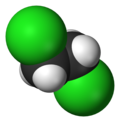 1,2-dichloroethane-3D-vdW.png


