Tunicate: Difference between revisions
CSV import |
CSV import |
||
| Line 79: | Line 79: | ||
[[Category:Tunicates]] | [[Category:Tunicates]] | ||
<gallery> | |||
File:Tunicate_komodo.jpg|Tunicate | |||
File:Bluebell_tunicates_Nick_Hobgood.jpg|Bluebell tunicates | |||
File:Botrylloides_violaceus_(cropped).jpg|Botrylloides violaceus | |||
File:Oikopleura_dioica.gif|Oikopleura dioica | |||
File:Appendicularia_(YPM_IZ_096169).jpeg|Appendicularia | |||
File:Pyrosoma_atlanticum.JPG|Pyrosoma atlanticum | |||
File:Salp_colony,_Aorangaia_PA171899.JPG|Salp colony | |||
File:Cyclomyaria.jpg|Cyclomyaria | |||
File:CionaintestinalisR.jpg|Ciona intestinalis | |||
File:Sea_Squirts_Didemnum_molle.jpg|Sea Squirts Didemnum molle | |||
File:Molgula_oculata_001.png|Molgula oculata | |||
File:Microcosmus_sabatieri.jpg|Microcosmus sabatieri | |||
</gallery> | |||
Revision as of 12:07, 18 February 2025
Tunicate
Tunicates, also known as urochordates, are a group of marine invertebrates that are part of the subphylum Tunicata. They are notable for their sac-like body structure and are found in oceans worldwide. Tunicates are closely related to vertebrates, sharing a common ancestor, and are considered an important group for understanding the evolution of chordates.
Description
Tunicates are characterized by their tough outer "tunic," which is made of a cellulose-like carbohydrate. This tunic provides protection and structural support. The body of a tunicate is divided into two main regions: the thorax and the abdomen. They possess a simple nervous system and a heart that can reverse the direction of blood flow.
Tunicates exhibit a wide range of forms and sizes, from solitary individuals to complex colonial structures. They can be sessile, attaching themselves to substrates, or free-floating in the water column.
Life Cycle
The life cycle of tunicates includes both sexual and asexual reproduction. Most tunicates are hermaphroditic, possessing both male and female reproductive organs. Fertilization typically occurs in the water column, and the resulting larvae are free-swimming. These larvae resemble tadpoles and possess a notochord, a defining feature of chordates.
After a brief planktonic stage, the larvae settle onto a substrate and undergo metamorphosis into the adult form. Some tunicates, such as those in the class Appendicularia, retain their larval characteristics throughout their life.
Classification
Tunicates are divided into three main classes:
- Ascidiacea: Also known as sea squirts, these are sessile tunicates that attach to surfaces. They can be solitary or colonial.
- Thaliacea: This class includes free-floating tunicates such as salps and pyrosomes. They are often found in open ocean environments.
- Appendicularia: Also known as larvaceans, these tunicates retain their larval form throughout their life and are free-swimming.
Ecology
Tunicates play a significant role in marine ecosystems. They are filter feeders, drawing in water through an incurrent siphon, filtering out plankton and other small particles, and expelling the filtered water through an excurrent siphon. This feeding process helps to clarify the water and recycle nutrients.
Some tunicates, particularly colonial species, can form dense mats that cover large areas of the seafloor, providing habitat for other marine organisms. However, certain species can become invasive, outcompeting native species and altering local ecosystems.
Research and Importance
Tunicates are of interest to scientists due to their evolutionary significance and their potential applications in biotechnology. Their simple body plan and genetic makeup provide insights into the evolution of more complex chordates, including vertebrates.
Additionally, tunicates produce a variety of bioactive compounds that have potential uses in medicine, including anti-cancer and anti-bacterial agents.
Related Pages
References
- Barnes, R. D. (1982). Invertebrate Zoology. Holt-Saunders International.
- Ruppert, E. E., Fox, R. S., & Barnes, R. D. (2004). Invertebrate Zoology: A Functional Evolutionary Approach. Brooks/Cole.
- Satoh, N. (2003). The Ascidian Tadpole Larva: Evolutionary Significance of Its Structure and Function. Canadian Journal of Zoology.
Gallery
-
 Tunicate in Komodo National Park
 -
 Bluebell tunicates
 -
 Botrylloides violaceus
 -
 Oikopleura dioica
 -
 Appendicularia
 -
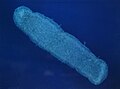 Pyrosoma atlanticum
 -
 Salp colony
 -
 Cyclomyaria
 -
 Ciona intestinalis
 -
 Sea Squirts Didemnum molle
 -
 Molgula oculata
 -
Tunicate in Komodo
-
 Microcosmus sabatieri
 -
 Catellocaula
 -
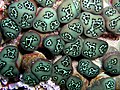 Green tunicate
 -
 Urochordate diagram
 -
 Pyrosoma
 -
 Oikopleura cophocerca
 -
 Ascidians
 -
 Rhopalaea Crassa
 -
Sea Squirts Didemnum molle
-
 Black and orange tunicate
 -
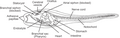 Urochordate anatomy
 -
 Ascidia
 -
 Sea Squirt


.jpg)

.jpeg)


_cophocerca_001.png)

_(4_cm).png)


-
Tunicate
-
Bluebell tunicates
-
Botrylloides violaceus
-
Oikopleura dioica
-
Appendicularia
-
Pyrosoma atlanticum
-
Salp colony
-
Cyclomyaria
-
Ciona intestinalis
-
Sea Squirts Didemnum molle
-
Molgula oculata
-
Microcosmus sabatieri
