Underwater habitat: Difference between revisions
CSV import |
CSV import |
||
| Line 70: | Line 70: | ||
[[Category:Underwater habitats]] | [[Category:Underwater habitats]] | ||
<gallery> | |||
File:2010_05_05_Unterwasserstation_Helgoland_Stralsund_k.JPG|Underwater habitat | |||
File:Underwater_Habitat_Type_3.jpg|Underwater habitat | |||
File:Underwater_Habitat_Type_4.jpg|Underwater habitat | |||
File:Man_in_the_Sea_1_-_Cylinder.jpg|Underwater habitat | |||
File:Conshelf_II_-_Starfish_(Wiki).jpg|Underwater habitat | |||
File:Conshelf_III.jpg|Underwater habitat | |||
File:Sealab_1.jpg|Underwater habitat | |||
File:SEALAB_II.jpg|Underwater habitat | |||
File:SEALAB_III.jpg|Underwater habitat | |||
File:HYDROLAB.jpg|Underwater habitat | |||
File:Hyrdolab.jpg|Underwater habitat | |||
File:EDALHAB01.jpg|Underwater habitat | |||
</gallery> | |||
Revision as of 12:22, 18 February 2025
Underwater Habitat
An underwater habitat is a structure designed to allow humans to live and work beneath the surface of the water for extended periods. These habitats are used for scientific research, exploration, and sometimes for recreational purposes. They provide a controlled environment where divers can decompress, rest, and conduct experiments without the need to return to the surface frequently.
History
The concept of underwater habitats dates back to the early 20th century, but it was not until the 1960s that significant advancements were made. The Conshelf projects, led by Jacques Cousteau, were among the first successful attempts to create underwater living spaces. These projects demonstrated the feasibility of humans living underwater for extended periods.
Design and Functionality
Underwater habitats are typically anchored to the seabed and are equipped with life support systems to provide air, remove carbon dioxide, and maintain a comfortable temperature and humidity. They often include living quarters, laboratories, and storage areas. Access to the habitat is usually through a moon pool, which allows divers to enter and exit the habitat while maintaining a dry interior.
Notable Underwater Habitats
- Conshelf II - A pioneering underwater habitat established by Jacques Cousteau in the Red Sea.
- SEALAB - A series of underwater habitats developed by the United States Navy for research purposes.
- Aquarius Reef Base - The only operational underwater habitat as of the 21st century, located off the coast of Florida.
- Tektite - An underwater laboratory used for scientific research in the late 1960s and early 1970s.
Applications
Underwater habitats are used for a variety of purposes, including:
- Scientific Research - Studying marine life, oceanography, and the effects of long-term underwater living on humans.
- Military Operations - Training and research for naval operations.
- Recreational and Commercial - Some habitats are used for tourism and underwater hotels.
Challenges
Living underwater presents several challenges, including maintaining a stable environment, ensuring a reliable supply of air and power, and dealing with the physiological effects of long-term exposure to increased pressure.
Related Pages
Gallery
-
 Unterwasserstation Helgoland
 -
 Underwater Habitat Type 3
 -
 Underwater Habitat Type 4
 -
 Man in the Sea Cylinder
 -
 Conshelf II - Starfish
 -
 Conshelf III
 -
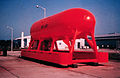 SEALAB I
 -
 SEALAB II
 -
 SEALAB III
 -
 Tektite I
 -
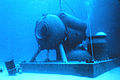 HYDROLAB
 -
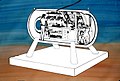 Hyrdolab
 -
 EDALHAB
 -
 Unterwasserstation BAH-1
 -
 Progetto Abissi 2007
 -
 Aquarius Laboratory
 -
 Aquarius in the Sea
 -
 Aquarius on Shore
 -
 La Chalupa Research Laboratory
 -
 Scott Carpenter Space Analog Station
 -
 GALATHEE
 -
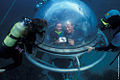 Aquabulle
 -
 HIPPOCAMPE
 -
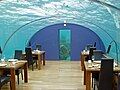 Ithaa Inside
 -
 Red Sea Star
 -
 Underwater Observatory in Eilat
 -
 Alpha Deep SeaPod


.jpg)


.JPG)


-
Underwater habitat
-
Underwater habitat
-
Underwater habitat
-
Underwater habitat
-
Underwater habitat
-
Underwater habitat
-
Underwater habitat
-
Underwater habitat
-
Underwater habitat
-
Underwater habitat
-
Underwater habitat
-
Underwater habitat
